
Enterprise IT teams evaluating commercial structured cabling contractors now prioritize BICSI credentials and documented testing protocols over project pricing, according to Integrated Technology Solutions, a Houston-based network infrastructure firm that published five procurement standards on August 3, 2026, based on intake patterns across projects in all 50 U.S. states.
TL;DR: Integrated Technology Solutions reports that enterprise buyers increasingly screen cabling contractors for industry certifications and testing compliance before discussing cost, reflecting a shift toward verifiable quality standards in infrastructure projects.
The five-point framework addresses procurement criteria that span backbone fiber engineering, integrated wireless-wired design, certification requirements, data center-grade standards, and performance testing. Joshua Roy, principal of Integrated Technology Solutions, said the cabling decision carries 20-year consequences because cable plants remain in place for the building’s lifespan while hardware cycles through multiple refreshes. The firm’s BICSI-certified technicians draw on 35 years of combined industry expertise to engineer commercial structured cabling and network systems from its Greater Houston base.
Backbone-First Fiber Engineering Replaces Endpoint-Out Build Sequence
The first standard prioritizes backbone fiber installation before endpoint provisioning. Integrated Technology Solutions engineers fiber optic cabling for both inside-plant and outside-plant deployments, allowing corporate campuses to connect buildings and equipment rooms under unified design specifications rather than discrete pull sequences. The firm handles Cat6A copper installations where full fiber rebuilds remain uneconomical, delivering 10-gigabit transmission across 100-meter runs.
“The cabling decision is a twenty-year decision. Hardware gets swapped every refresh cycle, but the cable plant stays in place for the life of the building, so we engineer and certify every run as if a data center depended on it,” Roy said in the August 3 release.
For occupied buildings, the company sequences copper-to-fiber migrations floor by floor to maintain department connectivity during backbone installation. Multi-site organizations apply the same engineering standards from headquarters projects to nationwide rollouts, according to the firm’s project documentation.
Integrated Wireless-Wired System Design Eliminates Subcontractor Finger-Pointing
The second standard treats structured cabling and managed Wi-Fi as interdependent system components. Every access point in multi-story office buildings depends on wired backhaul, making wireless performance directly contingent on underlying cable plant quality. The approach extends across low-voltage systems including audiovisual, digital signage, access control, and surveillance, consolidating accountability under single-partner management rather than four separate subcontractors.
“Wireless problems usually start in the cabling, which is why we design the wired and wireless layers together. When one partner owns the cabling, the Wi-Fi, and everything low-voltage around it, there is no one left to point the finger at,” Roy said.
BICSI Certification Provides Verifiable Standards Compliance on Critical Projects
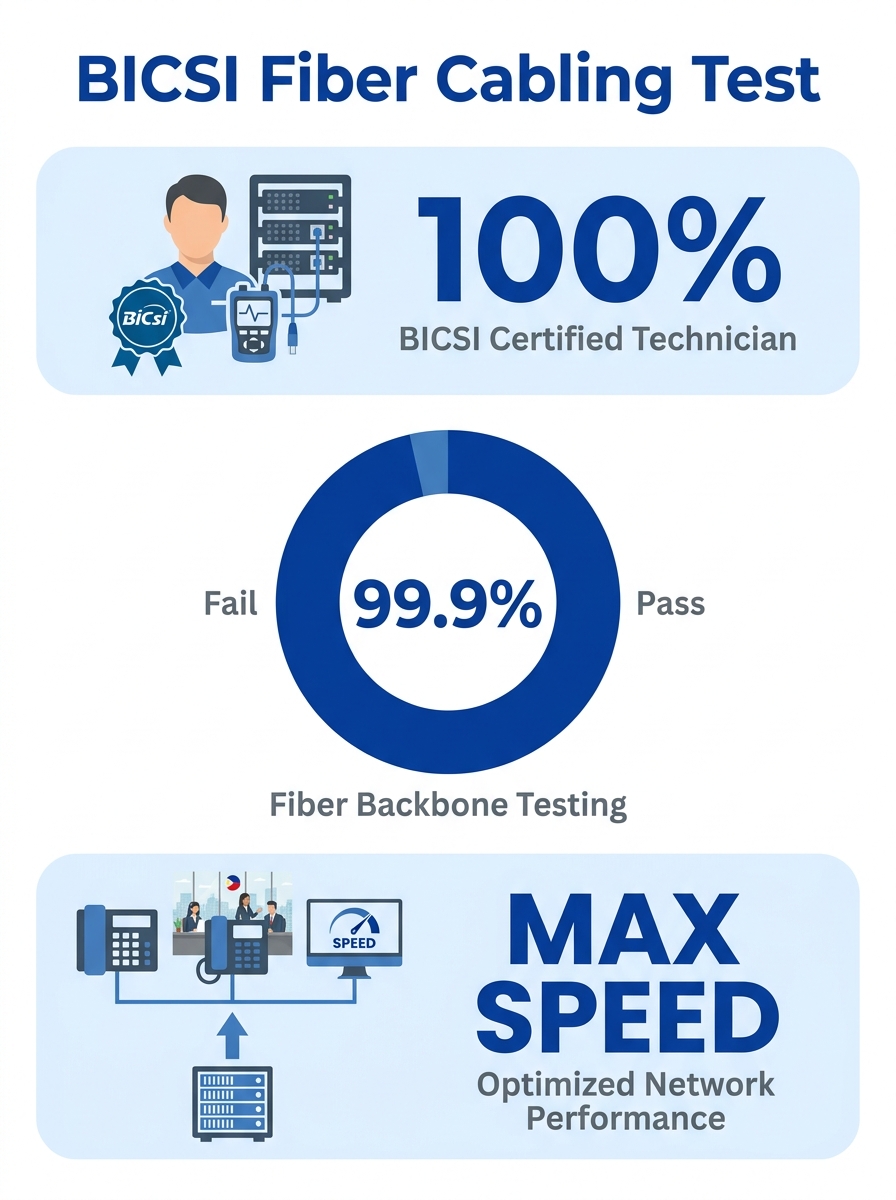
The third standard identifies BICSI-certified technician credentials as verifiable proof of standards compliance before project execution. Technicians trained and tested against industry design and installation protocols produce documented, third-party-verifiable work. Integrated Technology Solutions tests every terminated run against its category rating and delivers written certification results at handoff, establishing a complete plant record for facility owners.
Philippine enterprises evaluating data center solutions contractors face similar credential-verification requirements, particularly as national data center capacity expands toward 500 megawatts by 2028 and infrastructure procurement shifts from cost-driven to quality-driven evaluation frameworks.
Data Center-Grade Standards Set Commercial Infrastructure Benchmark
The fourth standard applies data center design criteria to commercial network infrastructure projects. Data center build-outs covering spine and backbone fiber, main distribution frame architecture, and top-of-rack switching set performance thresholds that translate to corporate environments. The firm engineers commercial cable plants to data center specifications regardless of building class.
Performance Testing Delivers Measurable Infrastructure Validation
The fifth standard mandates comprehensive testing across cable categories, link certification, and network performance metrics. Testing protocols verify transmission speeds, signal loss parameters, and crosstalk thresholds against category specifications before system acceptance. Written test reports document every installed run’s performance against industry benchmarks.
Context and Outlook
The shift toward credential-based contractor vetting reflects broader enterprise infrastructure procurement patterns as network dependencies intensify across Philippine business verticals. BPO call centers, hospitals, hotels, and government agencies upgrading campus networks face identical specification challenges when evaluating structured cabling contractors: verifying technical competence before price negotiations begin.
Philippine IT managers reviewing contractor proposals can apply parallel screening criteria by requesting BICSI or equivalent credential documentation, demanding written testing protocols for every installed run, and requiring fiber-first backbone engineering rather than endpoint-out deployments. The National Telecommunications Commission and Department of Information and Communications Technology do not mandate specific cabling credentials for private-sector projects, placing verification responsibility on enterprise procurement teams.
As Metro Manila, Cebu, and Davao data center construction accelerates and multi-site enterprises consolidate network operations, the cabling plant becomes the infrastructure layer with the longest replacement cycle and highest retrofit cost—making upfront credential vetting and testing compliance the primary cost-containment mechanism over 20-year facility lifecycles.