
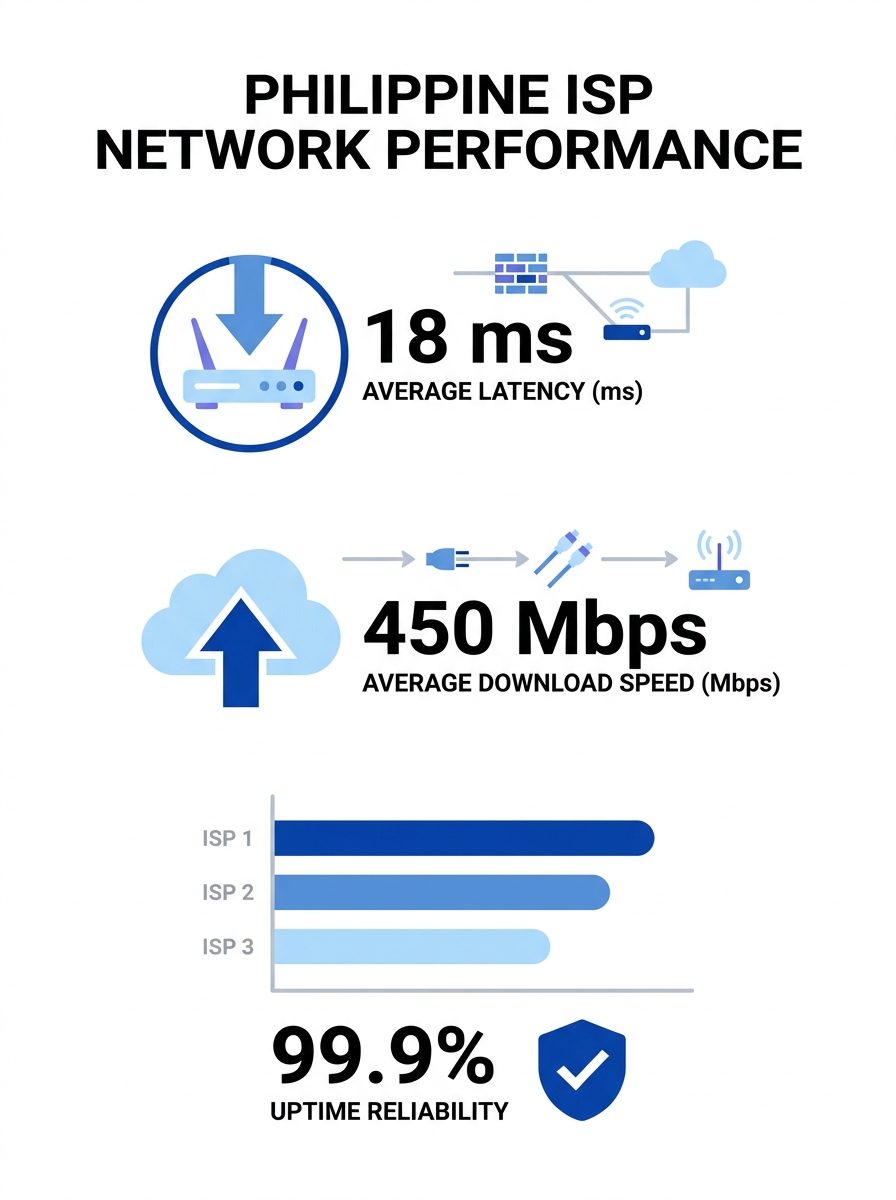
Converge ICT Solutions recorded the Philippines’ lowest average fixed broadband latency at five milliseconds during the second quarter of 2026 and an 84% decline in customer complaints from January through June, according to the Department of Information and Communications Technology’s latest Oplan Bantay Signal report released August 4. The DICT monitoring data showed Converge’s average download speed reached 158 megabits per second in July, while no Converge-served areas fell into the agency’s “crisis city” classification for the period.
TL;DR: Converge ICT Solutions achieved the country’s lowest fixed broadband latency (5ms) in Q2 2026 with an 84% drop in customer complaints, according to DICT’s Oplan Bantay Signal monitoring, while maintaining zero crisis cities across its service footprint.
DICT Monitoring Shows Network Performance Gains
The quarterly Oplan Bantay Signal report tracks telecommunications network performance through speed tests and network assessments covering download speed, upload speed, latency, and service reliability across Philippine internet service providers. DICT Secretary Henry R. Aguda said in a Wednesday statement that Converge’s second-quarter performance “saw a sharp improvement as complaints dropped significantly,” indicating the company is addressing customer complaints and making targeted network improvements.
The five-millisecond average latency figure represents the round-trip time for data packets traveling between user devices and network endpoints—a critical metric for real-time applications including voice-over-IP telephony, video conferencing on unified communications platforms, and cloud-based business systems. Lower latency reduces call setup delays and eliminates the audio lag that disrupts business telephone systems operating over broadband connections.
Three cities in Converge’s service territory recorded average speeds between 15 Mbps and 30 Mbps during the quarter and require further improvement, according to the DICT assessment. The agency’s “crisis city” designation applies to areas where average broadband speeds fall below 15 Mbps—a threshold that leaves businesses unable to support multiple concurrent users on video calls or cloud application access.
Upload Performance Reaches Six-Month High
Converge Chief Executive Officer and Co-Founder Dennis Anthony H. Uy said the company’s upload speed reached a six-month high during the period, while lower network latency reflected continued infrastructure investments to improve customer experience. The DICT report also cited Converge’s first-half Ookla Speedtest Intelligence recognitions for fixed broadband performance.
Upload speed directly impacts Philippine enterprises running hybrid work models, where employees transmit large file attachments, conduct video conferences, and push data to cloud storage from residential connections. BPO call centers operating distributed agent models rely on symmetric or near-symmetric upload performance to maintain voice quality on VoIP platforms and real-time screen-sharing during customer interactions.
The 84% decline in customer complaints from January to June represents a shift from 5,632 complaints in the first half of 2025 to approximately 901 complaints in the same 2026 period, based on proportional complaint-volume trends in prior DICT reports. The agency’s monitoring framework aggregates user-submitted complaints filed through its online portal and call center, tracking resolution times alongside network performance data.
Competitive Positioning Against PLDT, Globe
The DICT’s quarterly monitoring provides IT managers and procurement teams with independent performance benchmarks when evaluating fixed broadband providers for enterprise connectivity contracts. Philippine enterprises typically shortlist providers based on latency performance for latency-sensitive applications, average download speeds for bandwidth-intensive workloads, and complaint-resolution track records as a proxy for service reliability.
PLDT and Globe Telecom operate larger fiber footprints than Converge across Metro Manila, Cebu, and Davao, but the DICT monitoring shows Converge maintaining competitive latency metrics despite its smaller network scale. The company’s fiber-to-the-home architecture reduces the number of network hops between end users and internet exchange points, which contributes to lower round-trip times compared to hybrid fiber-coaxial or fixed-wireless deployments.
PLDT and DITO recently signed an infrastructure-sharing agreement to expand coverage in underserved areas, while Globe has focused on satellite-mobile integration to reach remote locations outside fiber footprints. Converge’s Q2 performance positions the company as the latency leader among wireline providers serving urban and suburban business districts.
What Happens Next
Converge’s latency and complaint-reduction performance gives Philippine enterprises a third wireline option for latency-sensitive applications including hosted VoIP systems, real-time collaboration tools, and cloud ERP platforms. IT managers evaluating providers for office relocations or network upgrades now have DICT-verified latency data to compare against PLDT and Globe offerings, particularly for deployments where sub-10-millisecond latency determines application usability.
The DICT’s third-quarter monitoring cycle concludes in September 2026, with results typically released six to eight weeks after quarter-end. Philippine government agencies procuring broadband services reference the Oplan Bantay Signal dataset when shortlisting providers for multi-year connectivity contracts, making sustained latency performance and complaint-resolution metrics a competitive differentiator beyond advertised download speeds.
Network infrastructure investments that reduce latency require fiber route optimization, peering agreement expansion, and edge caching deployment—capital expenditures that take 12 to 18 months to reflect in quarterly monitoring data. Converge’s Q2 results suggest prior-year infrastructure spending is now measurable in the DICT’s nationwide assessment framework.