
Philippine data center capacity is projected to reach 500 megawatts by 2028, more than tripling current levels of around 150 megawatts, according to property consultancy Santos Knight Frank, as the country’s positioning in AI and semiconductor supply chains drives demand for IT-ready office developments.
TL;DR: Data center capacity in the Philippines will expand from 150 MW to 500 MW by 2028, driven by AI infrastructure requirements and the Luzon Economic Corridor and Pax Silica initiatives, according to [Santos Knight Frank](https://bworldonline.com/corporate/2026/07/23/765302/it-ready-office-developments-seen-gaining-traction-as-data-center-capacity-expands).
The expansion follows government-backed infrastructure initiatives including the Luzon Economic Corridor and Pax Silica network, positioning the Philippines as a regional hub for artificial intelligence and semiconductor manufacturing. Santos Knight Frank Chairman and CEO Rick Santos said during a July 22 media briefing that these programs represent “the most exciting initiatives to date, following the business process outsourcing era, positioning the Philippines as a serious player in the region’s AI and semiconductor supply chain.”
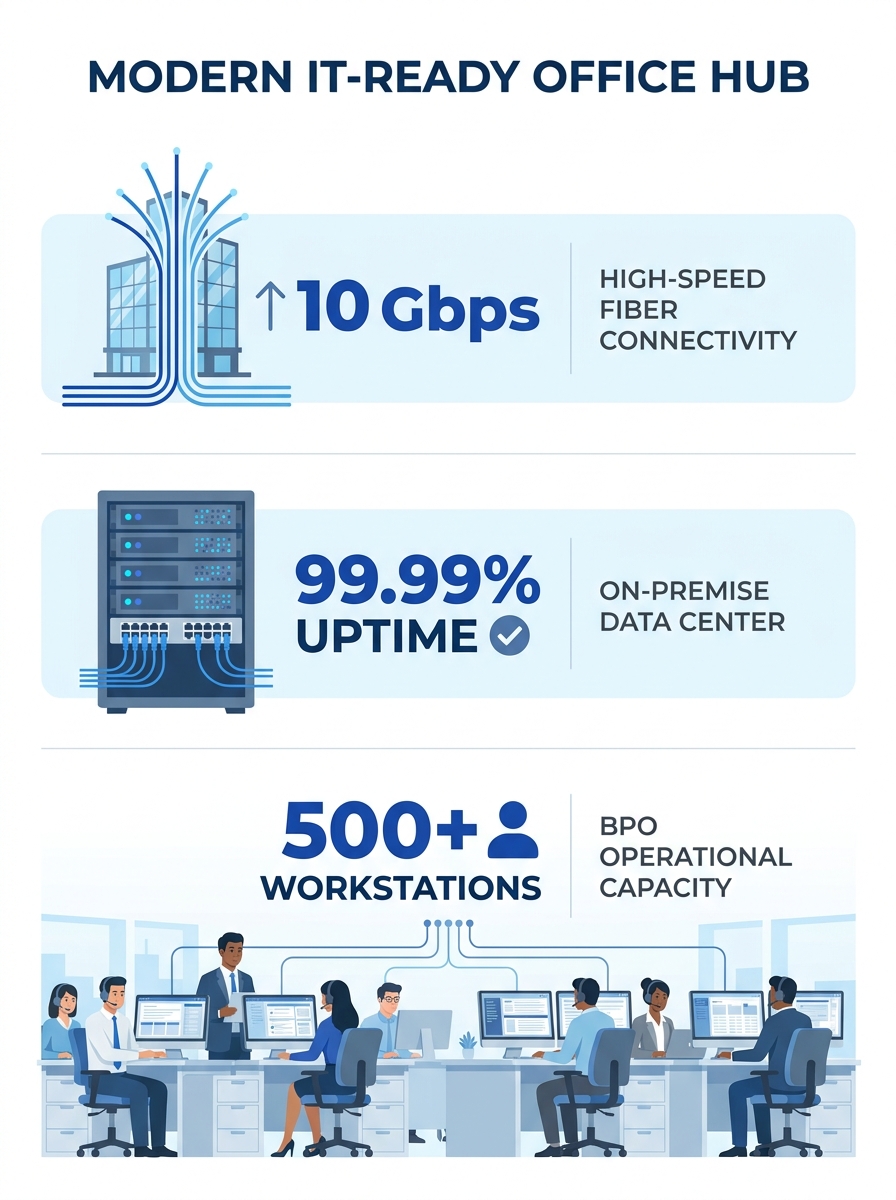
The infrastructure push is creating parallel demand for office developments equipped with advanced digital connectivity and data center solutions capable of supporting AI-driven operations. Metro Manila recorded office net absorption of 257,000 square meters in the first half of 2026, up 28.5% from the same period in 2025, according to the consultancy’s data.
Data Center Expansion Tied to Economic Security Zone
The proposed 4,000-acre Economic Security Zone in New Clark City, Tarlac, is envisioned as the first AI-native industrial acceleration hub under the Pax Silica network, according to Santos Knight Frank. The project aims to reduce dependence on non-allied technology supply chains while using Philippine nickel, copper, and gold resources for semiconductor manufacturing infrastructure.
The industrial momentum is expected to support demand for workspaces designed for complex logistics operations and technical talent, the firm stated. Philippine data center expansion has previously encountered power infrastructure constraints, making the New Clark City location strategically positioned given its planned energy allocations.
Office Developers Pursue WiredScore Certification
Occupiers are increasingly favoring higher-quality buildings with advanced digital infrastructure, prompting developers to seek WiredScore certification, which assesses a building’s digital connectivity and IT infrastructure readiness. Morgan McGilvray, senior director at Santos Knight Frank, said during the briefing that “WiredScore knows what tenants want from a building IT-wise nowadays. They know what the multinationals are looking for, they know what [are] the bare minimums, they know what is preferred.”
The certification evaluates structured cabling, network redundancy, and carrier connectivity across office developments. McGilvray stated that buildings with WiredScore accreditation help attract tenants because “the tenants know that this building has what they need from an IT building,” though he noted the certification will take time to build market momentum.
Taguig recorded Metro Manila’s lowest office vacancy rate at 9% while posting the highest average asking rent at P1,368 per square meter, according to Santos Knight Frank’s first-half 2026 data. The consultancy cited Arthaland Corp.’s Savya Financial Center in Arca South and Menarco Development Corp.’s Menarco Tower in Bonifacio Global City as examples of smart-enabled office developments equipped with advanced structured cabling and digital infrastructure.
Reading Between the Lines
The 233% capacity expansion target from 150 MW to 500 MW over a two-year period signals an aggressive build-out schedule that will test the Philippine power grid and cooling infrastructure in data-center-dense zones. For IT managers evaluating colocation or build-own strategies, the timeline suggests availability may tighten in 2027 before new capacity comes online, particularly in Metro Manila where Taguig’s 9% vacancy rate already indicates constrained supply.
The WiredScore certification trend introduces a third-party verification layer that Philippine enterprises can use to pre-qualify office space for VoIP, cloud, and hybrid network deployments. Buildings without carrier-neutral meet-me rooms or redundant fiber pathways will face increasing tenant resistance as multinationals demand enterprise-grade connectivity as a baseline rather than an upgrade.
The Pax Silica positioning directly competes with Malaysia’s semiconductor hub investments and Vietnam’s expanding electronics manufacturing zones. If the 4,000-acre Economic Security Zone materializes with reliable power and fiber backhaul, Philippine data center operators gain a domestic anchor tenant base beyond BPO and hyperscale cloud, reducing dependence on offshore demand cycles that characterized the PLDT data center REIT market positioning.