
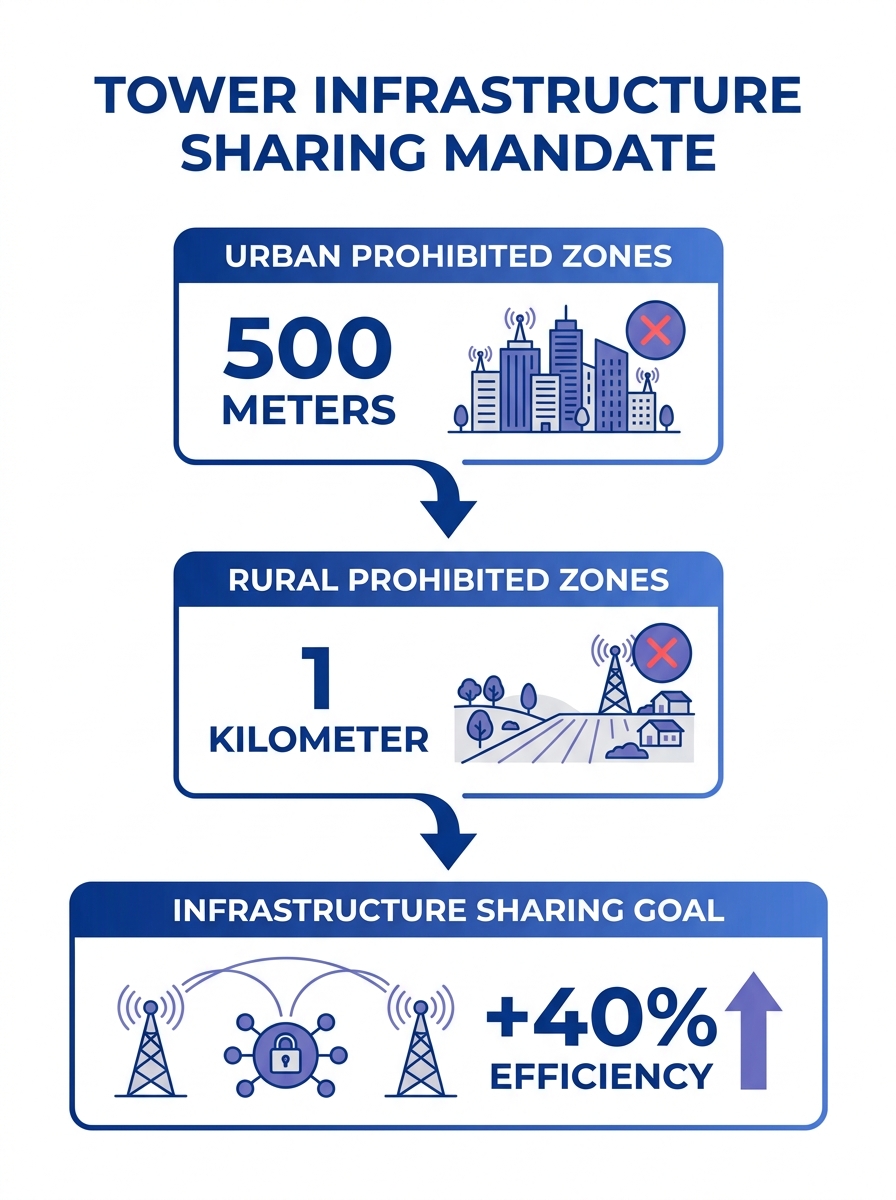
The Department of Information and Communications Technology issued a department circular on July 20 prohibiting telecommunications providers from constructing new towers within 150 meters of existing structures in high-density districts and within 1,000 meters in rural areas, according to Philstar. The regulation amends sections of a 2020 department order to enforce Section 16 of Republic Act 12234, the Konektadong Pinoy Act, which mandates passive telecommunications tower infrastructure sharing among carriers.
TL;DR: DICT mandates infrastructure sharing by preventing new telecom towers within 150m in urban areas and 1,000m in rural zones, with written approval required for exceptions under the Konektadong Pinoy Act.
The revised circular directly targets asset duplication across Metro Manila, Cebu, and Davao high-density corridors where competing carriers have historically deployed overlapping infrastructure. Telecommunications providers must now secure written approval from the DICT before constructing any tower within the prohibited proximity radius of an existing passive telecommunications tower infrastructure unit.
Exemption Criteria and Technical Waivers
The DICT will waive the proximity restriction under three specific conditions: when an existing tower cannot accommodate equipment upgrades to support projected demand, when wireless technology specifications require close-proximity deployment, or when topographical constraints prevent alternative placement, the circular states.
Independent tower companies—which own approximately 60 percent of Philippine telecommunications infrastructure—are explicitly prohibited from enforcing infrastructure restrictions on shared assets or limiting equipment brands installed on co-located towers. The circular adds ancestral domain and heritage preservation considerations to future project approval criteria, affecting deployment planning in Cordillera Administrative Region and Mindanao provinces where indigenous land rights intersect with network expansion requirements.
Tower Infrastructure Definition Expanded
The DICT clarified passive telecommunications tower infrastructure terminology to include masts, monopoles, lattice towers, rooftop installations, and data transmission equipment necessary for consumer connectivity. The expanded definition addresses industry confusion over which structures qualify for mandatory sharing under the Konektadong Pinoy Act provisions.
“The agency placed upon itself the power to approve or disallow any agreement entered into by a grantee that could be anticompetitive to industry peers,” the circular states, establishing DICT oversight of all infrastructure-sharing agreements between major carriers and new market entrants.
The regulatory shift builds on existing PLDT and DITO infrastructure cooperation precedents while imposing standardized distance requirements that previous voluntary agreements did not mandate. Enterprise IT managers evaluating network provider contracts will need to verify tower-sharing compliance as carriers adjust to the proximity restrictions, particularly in business district deployments where BPO call centers, hospitals, and hotels require guaranteed uplink capacity.
Market Entry Barrier Reduction
Republic Act 12234 reduces capital requirements for new telecommunications operators by preventing asset duplication and mandating co-location. The July 20 circular operationalizes the law’s infrastructure co-use provisions, which aim to attract investment by lowering the estimated P15-billion to P25-billion entry cost for nationwide mobile network deployment.
The National Telecommunications Commission will coordinate with DICT on enforcement procedures for the proximity radius requirements. Tower companies have 90 days from the circular’s July 20 issuance to submit existing infrastructure location data to DICT for baseline mapping of high-density and rural classification zones.
For enterprises evaluating network redundancy strategies, the mandatory sharing policy introduces dependency risk where multiple carriers rely on a single physical tower structure. IT operations leads should verify provider tower ownership versus lease arrangements when building VoIP networks or designing IP telephony platforms that require guaranteed uptime for customer-facing voice channels.
Why This Matters Now
Philippine telecommunications infrastructure costs have historically deterred new market entrants, concentrating carrier competition among three major providers across enterprise and government segments. The 150-meter urban proximity ban forces existing carriers to negotiate co-location terms rather than deploying competing towers within visual sight of each other—a pattern common in Makati, Ortigas, and Bonifacio Global City business districts where site acquisition costs exceed P500,000 monthly per location.
The policy directly impacts enterprise network planning timelines. Companies negotiating carrier SLAs for new office locations or data center connectivity must now account for mandatory infrastructure-sharing dependencies that introduce coordination delays when carriers dispute equipment priority or upgrade schedules on shared towers. Government agencies deploying unified communications systems across regional offices should verify that provider tower agreements include uptime guarantees that survive co-location disputes.
Independent tower companies control the majority of Philippine telecommunications infrastructure, making the DICT’s prohibition on equipment brand restrictions and anticompetitive lease terms essential to preventing vertical foreclosure. IT managers evaluating 5G enterprise network upgrades should confirm that selected carriers hold enforceable co-location rights on towers serving target deployment zones rather than assuming future access, as the July 20 circular shifts bargaining power toward tower lessors who now must accommodate multiple tenants under regulatory mandate.