
Globe Telecom launched commercial Starlink Direct-to-Cell service across the Philippines on June 30, making the country the first in Southeast Asia to deploy satellite-to-mobile connectivity that bypasses traditional cell towers and reaches an estimated 4 percent of the population—roughly 450,000 Filipinos—currently outside terrestrial network coverage, according to Gulf News.
TL;DR: Globe Telecom deployed commercial Starlink Direct-to-Cell service nationwide on June 30, 2026, extending satellite-based mobile connectivity to underserved areas without relying on conventional towers after receiving National Telecommunications Commission approval.
The National Telecommunications Commission cleared Globe for commercial deployment following successful disaster-response testing during a magnitude 7.8 earthquake that struck South Cotabato, Sultan Kudarat, and Sarangani in June 2026. The satellite system supported emergency communications for more than 150,000 Globe subscribers in affected areas when terrestrial infrastructure failed, the filing shows.
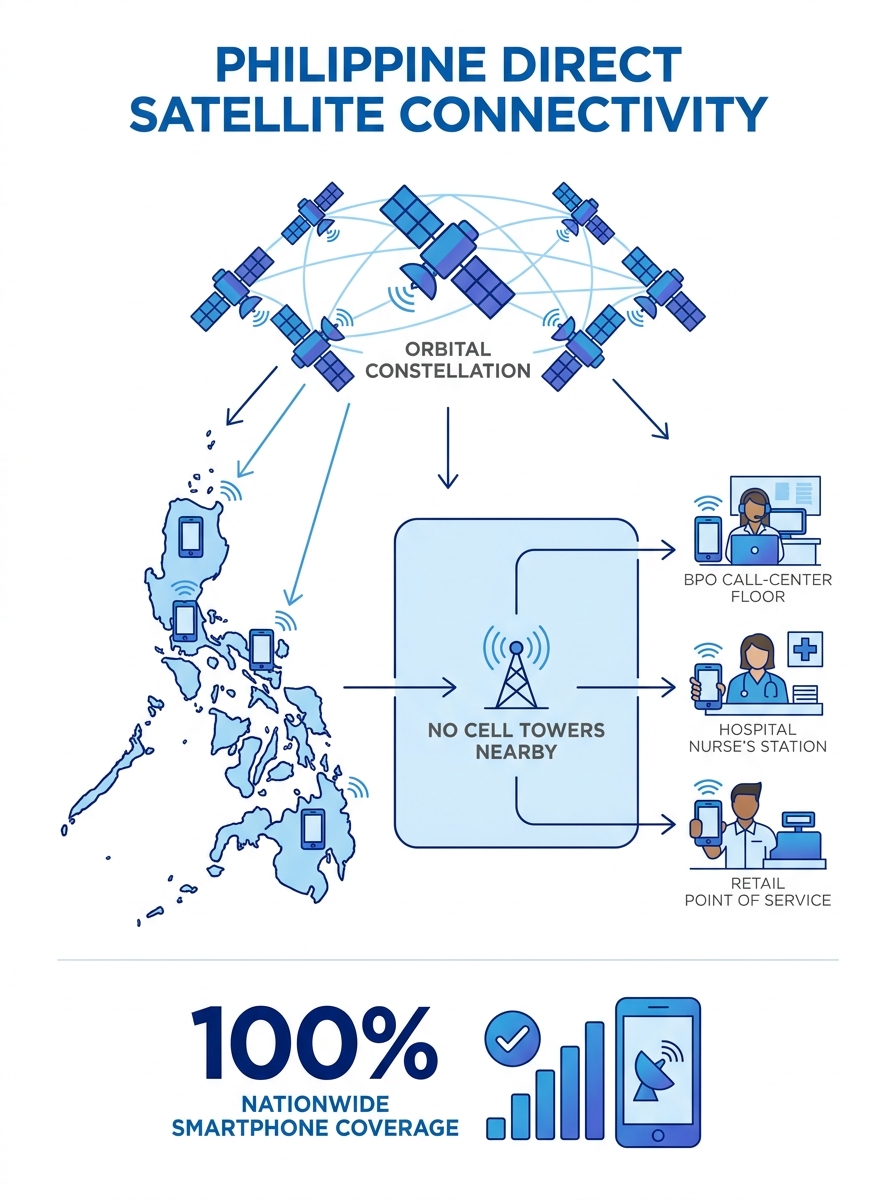
The service connects compatible Android LTE smartphones directly to Starlink’s constellation of more than 650 low-Earth orbit satellites, enabling SMS, messaging applications, voice and video calls, navigation services, and mobile data without roaming charges inside Philippine borders. Globe subscribers with supported devices and active SIM cards can access the network automatically in areas where traditional cell coverage is unavailable.
How the Infrastructure Works
Starlink Direct-to-Cell operates through satellite roaming architecture that treats SpaceX’s orbital constellation as an extension of Globe’s terrestrial network. The system does not require specialized handsets or additional hardware beyond Android LTE devices already in circulation across Globe’s subscriber base.
The 650-plus satellites orbit at altitudes between 340 and 614 kilometers, significantly lower than traditional geostationary communications satellites positioned at 35,786 kilometers. Lower orbital altitude reduces latency and signal path loss, two persistent problems in satellite-based voice and data systems that have limited commercial viability in the past.
Globe President and Chief Executive Officer Carl Cruz said the deployment extends coverage beyond the physical constraints of tower-based infrastructure. “The commercial launch allows us to ensure people remain connected in remote and disaster-stricken areas,” Cruz said in the operator’s statement.
Geographic and Disaster-Response Context
The Philippines comprises more than 7,000 islands spread across 300,000 square kilometers, creating persistent gaps in terrestrial mobile coverage where tower construction remains economically unviable or physically impractical. The archipelago sits along the Pacific Ring of Fire and the typhoon belt, facing an average of 20 tropical cyclones annually alongside frequent seismic activity.
Traditional disaster-response communications rely on portable cell-on-wheels units, satellite phones, or emergency radio systems—equipment that requires deployment time and specialized training. Direct-to-cell satellite service provides an always-on backup layer that activates automatically when towers lose power or backhaul connectivity.
The June 2026 earthquake in Mindanao damaged terrestrial infrastructure across a 180-kilometer radius. Globe activated satellite connectivity for affected subscribers without manual intervention or device changes, the company’s technical brief shows.
Regulatory and Market Position
The NTC approval positions Globe as the sole commercial satellite-to-mobile operator in the Philippine market under current licensing frameworks. The regulator cited support for the government’s digital inclusion targets and infrastructure resilience mandates in its clearance statement.
Globe did not disclose wholesale capacity pricing from Starlink or whether the satellite service carries usage limits beyond standard mobile plan allocations. The operator confirmed no additional subscription fees apply for satellite access within the Philippines, treating orbital connectivity as equivalent to terrestrial roaming between Globe’s own cell sites.
The deployment follows NTC approval granted on June 29, 2026, which authorized nationwide commercial service after a multi-month testing phase. The regulatory clearance did not specify minimum service-level agreements for satellite uptime or performance metrics.
Why This Matters Now
Philippine enterprises operating distributed facilities—BPO centers in Cebu and Davao, provincial hospital networks, hotel chains across resort islands, and manufacturing plants in remote economic zones—gain a backup communications path that functions independently of fiber, microwave, and terrestrial wireless links. The satellite layer provides SMS and voice connectivity during typhoon-related outages that routinely sever fixed infrastructure for 48 to 96 hours in affected regions.
Government agencies coordinating disaster response across multiple islands now have a connectivity option that survives localized infrastructure failures without deploying emergency equipment. The technology proved operationally viable during the South Cotabato earthquake, supporting a subscriber population equivalent to a mid-sized provincial city without advance preparation.
For IT and operations leaders evaluating network resilience strategies, satellite-to-cell represents an emerging alternative to VSAT terminals and dedicated satellite phones—both of which require separate devices, training, and procurement cycles. The service activates on existing handsets when terrestrial networks fail, reducing the operational complexity of maintaining parallel emergency communications systems.