
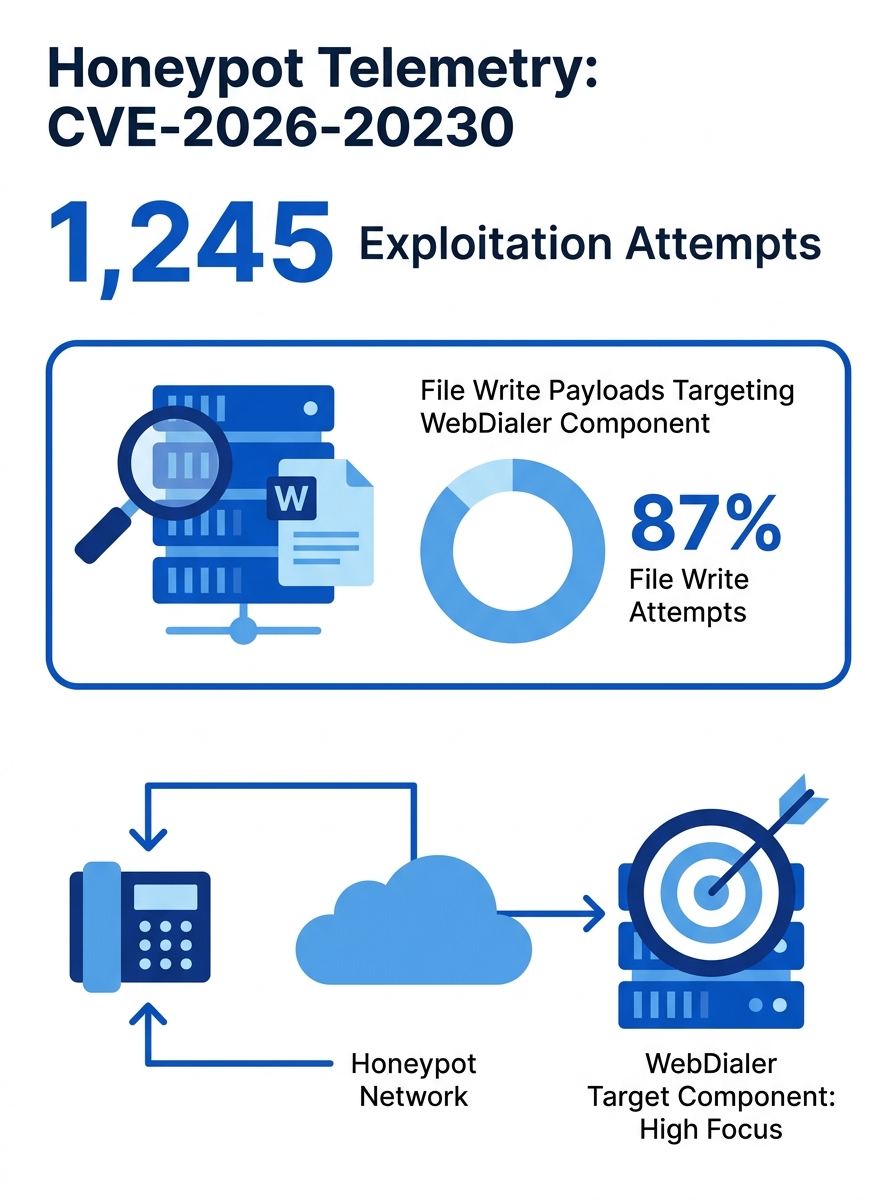
Threat intelligence firm Defused disclosed June 23 that attackers are actively exploiting CVE-2026-20230, a high-severity server-side request forgery vulnerability in Cisco Unified Communications Manager and Unified CM Session Management Edition that allows unauthenticated remote attackers to write arbitrary files and gain root privileges on vulnerable devices, according to observations published on X. Cisco patched the CVSS 8.6-rated flaw June 3 after SSD Secure disclosed the issue privately, but exploitation attempts appeared over the June 21-22 weekend originating from a single IP address targeting the WebDialer component with file:// URI payloads.
TL;DR: Attackers are exploiting CVE-2026-20230 in Cisco Unified CM to write test files to vulnerable devices in what appears to be reconnaissance ahead of broader exploitation campaigns.
Exploitation Pattern and Attack Vector
Defused’s honeypot telemetry captured exploitation attempts writing a text file named ‘/tmp/cve-2026-20230-test.txt’ to targeted systems, indicating reconnaissance activity rather than immediate weaponization. The attacks originated from a single IP address and demonstrated properly constructed file:// payloads designed to identify vulnerable Cisco Unified CM and Unified CM SME installations still running unpatched software three weeks after Cisco’s security advisory.
The vulnerability resides in the WebDialer component’s handling of user-supplied URLs. Cisco’s June 3 advisory stated: “This vulnerability is due to improper input validation for specific HTTP requests. An attacker could exploit this vulnerability by sending a crafted HTTP request to an affected device. A successful exploit could allow the attacker to write files to the underlying operating system that could be used later to elevate to root.”
SSD Secure published a technical write-up and proof-of-concept exploit June 23 after exploitation was publicly disclosed, documenting how unauthenticated attackers can abuse the flaw to force the application to write arbitrary files using file:// URIs. The researchers demonstrated that exploitation requires obtaining the target system’s hostname before executing the file-write attack, but showed that hostname information can be retrieved from the device itself before exploitation.
Scope and Remediation Timeline
Cisco Unified Communications Manager serves as the call-processing core for enterprise IP telephony deployments across Philippine BPOs, hospitals, hotels, universities, and government agencies running on-premise unified communications infrastructure. The platform handles SIP registration, call routing, media control, and administrative functions for thousands of voice endpoints in large-scale deployments.
The June 3 security update addressed the vulnerability across all supported Unified CM and Unified CM SME releases. No workaround exists for organizations unable to apply patches immediately. Defused noted the flaw had not been added to CISA’s Known Exploited Vulnerabilities catalog at the time of their disclosure, though active exploitation typically triggers KEV listing within days.
Philippine IT managers running Cisco Unified CM should prioritize patch application given the three-week window attackers have had to develop exploit tooling. Organizations that deferred the June 3 update now face elevated risk of file-write attacks designed to drop webshells and establish persistent root access on call-processing infrastructure. The reconnaissance activity observed by Defused suggests attackers are building target lists ahead of broader campaigns.
Technical Details and Root Access Path
SSD Secure’s technical analysis explained that by controlling both the file path and the content written to disk, an attacker can exploit the SSRF bug to achieve remote code execution and ultimately gain root privileges on vulnerable devices. The file-write primitive allows dropping scripts or binaries to locations accessible by the system’s privilege escalation paths.
The vulnerability affects the WebDialer API, which enterprise users typically access to initiate calls from web browsers without launching a separate phone application. The component’s URL parsing logic fails to properly validate file:// scheme URIs submitted through specific HTTP request parameters, allowing attackers to redirect file operations to arbitrary operating system paths.
Organizations running Unified CM in hybrid architectures that connect legacy PBX systems to SIP-based IP telephony face compounded risk if the vulnerable server acts as a session border controller or trunk gateway. Compromising the Unified CM server grants attackers visibility into call metadata, voicemail storage, user directories, and potentially the ability to intercept or redirect calls across the entire telephony infrastructure.
Context and Outlook
The active exploitation of CVE-2026-20230 underscores persistent security risks in enterprise unified communications platforms that Philippine IT teams must address through systematic patch management and security hardening controls. Cisco Unified CM vulnerabilities carry elevated business impact because the platform processes voice communications for entire organizations—root access to a single CM server can compromise thousands of endpoints, voicemail boxes, and call records.
The three-week delay between Cisco’s June 3 patch release and observed exploitation suggests attackers monitored the advisory for technical details before developing exploit code. SSD Secure’s decision to withhold public proof-of-concept details until after exploitation appeared demonstrates responsible disclosure practice, but the June 23 technical write-up will accelerate weaponization by additional threat actors. Philippine enterprises that have not yet applied the June 3 update should treat this as a critical-priority remediation following the same assessment framework used for earlier Cisco CM vulnerabilities.
Organizations running Unified CM should audit WebDialer usage and consider disabling the component if not required for business operations, reducing attack surface while patch testing progresses. The reconnaissance pattern observed by Defused—writing test files rather than immediately deploying webshells—gives defenders a brief window to patch before more aggressive exploitation begins, but that window will close as exploit tooling matures and spreads across attacker communities.