
Replacing degraded, undocumented copper runs with a TIA-942-compliant Cat6A cabling system eliminated 40% of recurring network incidents at a 1,200-seat Philippine BPO facility. The root cause was never the switches, the firewalls, or the ISP. It was the physical layer underneath everything else.
The Physical Layer Problem Nobody Budgets For
An ASEAN infrastructure study found that network failures account for 35% of all unplanned outages across enterprise operations in the region, with the median cost of high-business-impact events reaching USD 2.5 million per hour. Philippine BPO operations absorb a disproportionate share of that pain because their facilities often inherit cabling from prior tenants, expand floor capacity faster than IT can properly wire it, and run voice and data traffic over the same copper that was pulled during an original fit-out five, seven, or ten years ago. The incident tickets show up as “call drops,” “CRM timeouts,” or “switch port flapping,” and the network team spends its week chasing symptoms across the application stack while the actual fault sits behind a ceiling tile in a bundled, unlabeled, heat-stressed cable pathway.
The pattern is consistent across BPO call centers in Cebu, Davao, Clark, and Metro Manila. A facility opens with a clean enough install, maybe Cat5e or early Cat6, pulled by the building contractor rather than a cabling specialist. Over three to five years, the operation scales from 400 seats to 1,200. New rows of workstations get patched into the nearest available switch port using whatever cable length is on hand. Patch panels fill beyond their port counts. Nobody updates the floor plan documentation because there was never documentation to begin with. The result is what the industry calls spaghetti wiring, and it degrades signal integrity in ways that don’t trip a hard alarm but generate a steady stream of intermittent errors that inflate mean time to repair and mask the true failure source.
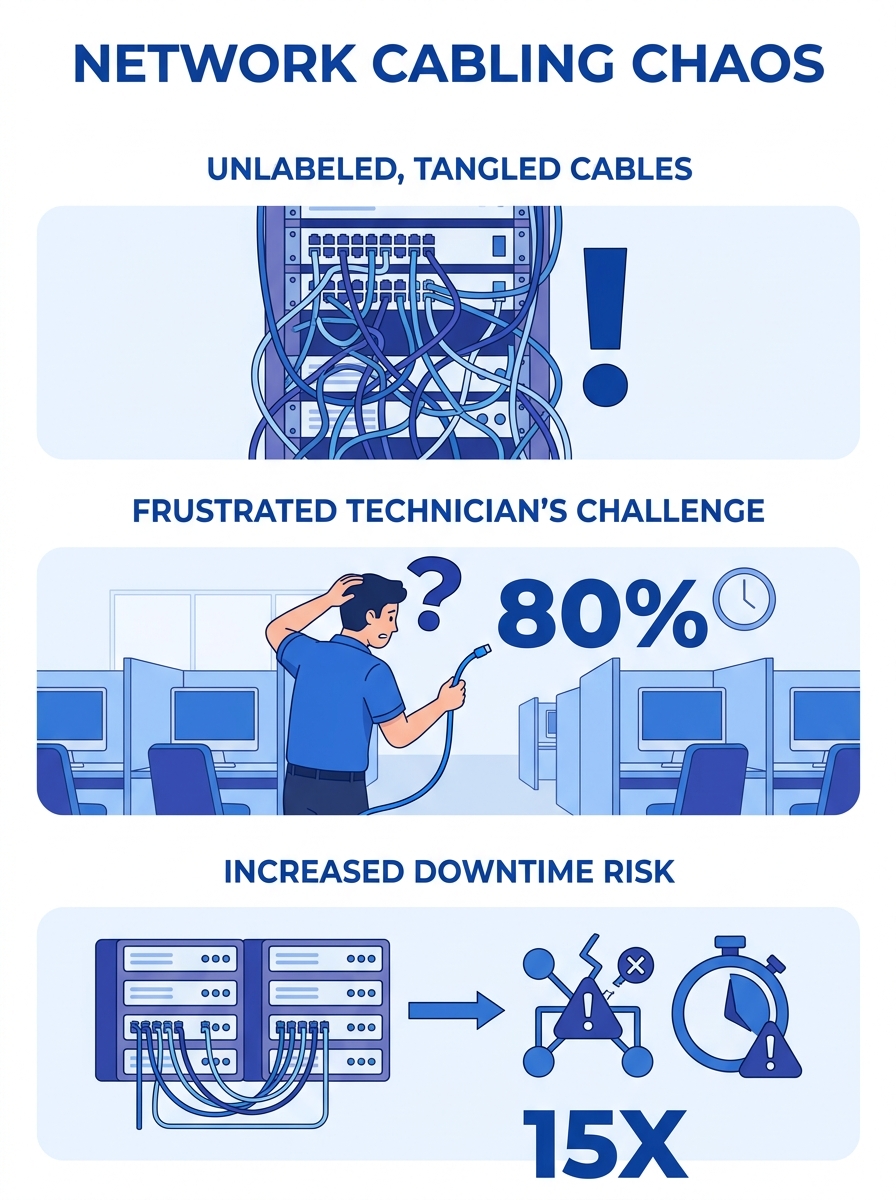
What makes this especially damaging for contact-center operations is that VoIP and real-time CRM sessions are far less tolerant of bit errors and latency spikes than email or file transfers. A cable that’s been bent past its minimum bend radius, terminated without proper testing, or run parallel to fluorescent lighting ballasts will still pass basic link-up tests. But it’ll inject enough crosstalk and return loss to degrade a G.711 voice stream or cause a thin-client session to freeze for 200 milliseconds, which is an eternity when an agent is mid-call with a customer. If you’ve ever pulled your VoIP call quality monitoring checklist and found no obvious QoS or bandwidth problems, the cabling plant is where you should look next.
Tearing Out Seven Years of Accumulated Cable Debt
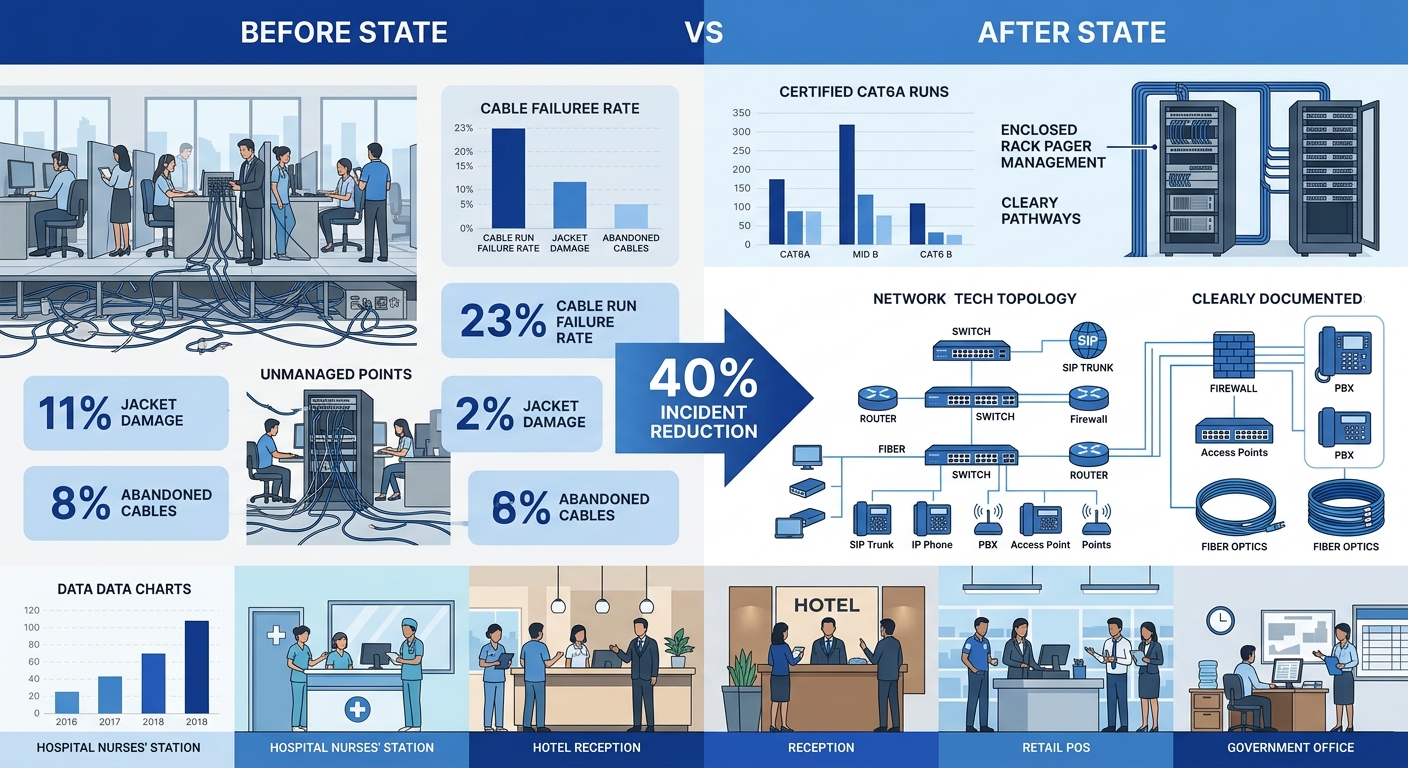
The rebuild in this case started with a full physical-layer audit: every horizontal run mapped from patch panel to workstation, every cable tested with a Fluke DSX CableAnalyzer to TIA-568.2-D Cat6A permanent-link specifications, and every undocumented splice, coupler, and unauthorized extension identified and flagged. The audit alone took two weeks across three production floors and revealed that 23% of existing runs failed the Cat6A alien crosstalk test, 11% had been damaged by cable ties cinched tight enough to deform the jacket, and roughly 8% were unterminated or abandoned cables occupying pathway space and generating heat inside congested conduit. ACIS IT Solutions, a managed infrastructure provider, describes this kind of remediation as “organizing and tidying up the wires and cables in your network closet or data centers” and recommends routine inspections precisely to avoid the kind of accumulated debt this facility had let grow unchecked.
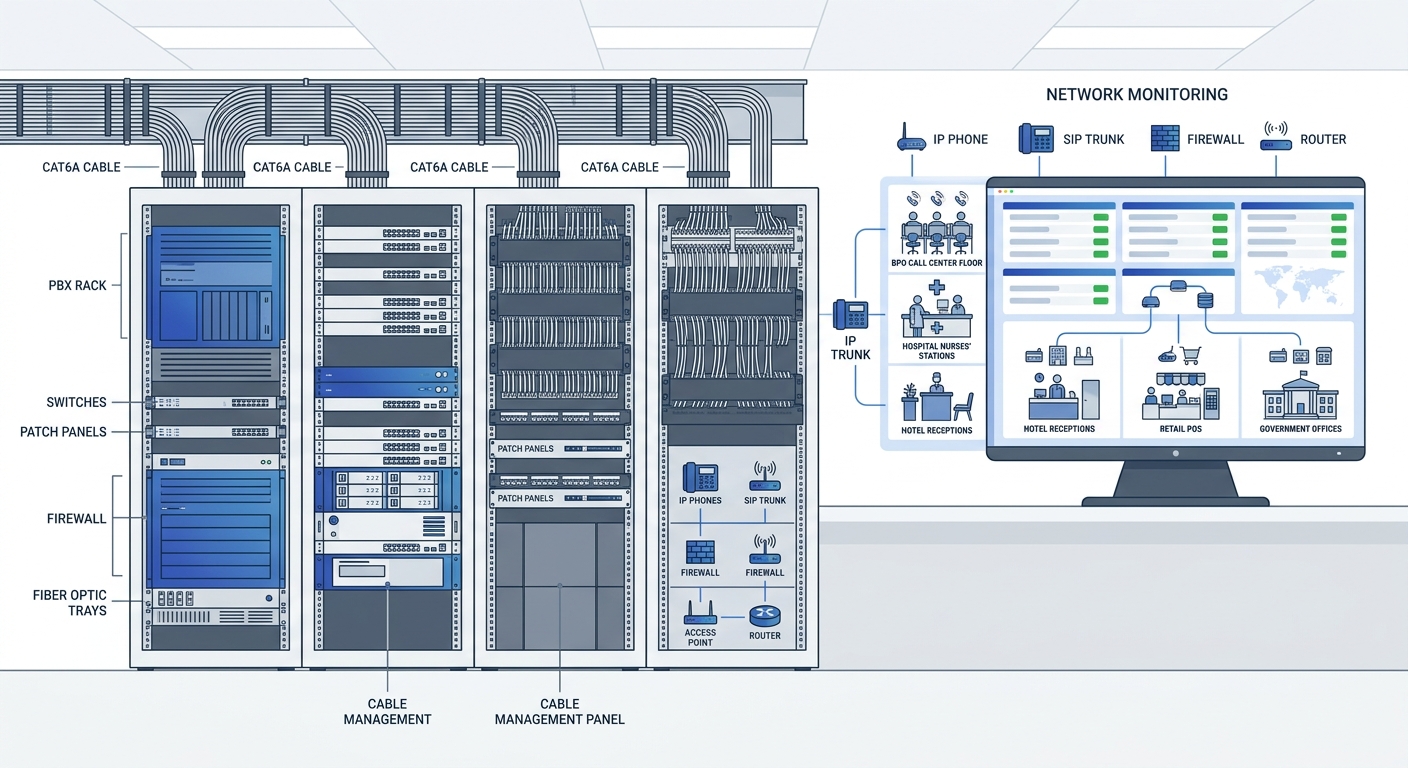
The replacement spec called for shielded Cat6A throughout, terminated to Panduit patch panels in enclosed racks with proper cable management, with a maximum channel length of 90 meters and 10-meter combined patch cord allowance per TIA standards. The team pulled all new runs rather than attempting to remediate existing cables, because testing showed that damaged cables re-terminated to new keystones still failed alien crosstalk requirements at 500 MHz. This is the critical technical point that many facilities miss: a Cat6A BPO upgrade requires new media, new terminations, and certified test results for every link, not partial fixes applied to aging plant. Turn-Key Technologies’ structured cabling guide reinforces this principle, noting that a standards-compliant infrastructure must address the full path from telecommunications room to work area outlet as an integrated system.
Twenty-three percent of existing cable runs failed alien crosstalk testing, and 11% had jackets deformed by over-tightened cable ties. The physical layer had been silently degrading for years.
The cutover happened in phases, one floor per production weekend, with the old cabling left energized until the new runs were tested and certified. Each phase took 48 hours of continuous labor, and the facility operated on temporary wireless bridges during the transition windows. That phasing strategy is worth noting because many BPO operators delay cabling remediation projects out of fear that the cutover itself will cause more downtime than the problems it’s meant to solve. In practice, a phased weekend approach keeps production-hour impact to zero if you plan the work around shift schedules. Facilities that have gone through multi-site cutover planning for PBX consolidations will recognize the same sequencing discipline applied here at the physical layer.
Why Incident Counts Dropped After the Rebuild
The 40% figure comes from comparing the facility’s ITSM ticket volume in the 90 days before the final cutover phase against the 90 days after, filtering for network-classified incidents only. The categories that dropped most sharply were intermittent connectivity loss (down 62%), VoIP quality complaints (down 54%), and switch port errors requiring manual intervention (down 38%). The categories that held steady were ISP-related outages and application-layer bugs, which is exactly what you’d expect when the intervention targets the physical layer alone.
The mechanism behind that reduction is straightforward once you understand what bad cabling actually does to a network. Every cable run that fails its crosstalk or return loss specification injects noise at the physical layer that the switch port’s auto-negotiation and error-correction logic tries to compensate for. When it can’t compensate, the port cycles, the link drops, the agent’s session freezes, and someone opens a ticket. When it can compensate, the port stays up but at reduced throughput or with elevated frame check sequence errors that accumulate slowly until a threshold is crossed. Philippine call center infrastructure running 100 or more concurrent G.711 RTP streams per floor has essentially no margin for this kind of degradation, because voice codecs don’t retransmit lost packets the way TCP-based applications do. A single bad cable run sharing pathway space with 47 good runs can induce enough alien crosstalk to degrade all 48 links in that bundle. Research from El Arafy’s infrastructure analysis confirms that structured cabling systems reduce troubleshooting time significantly because problems can be isolated to individual links rather than chased across an undocumented tangle.
The indirect operational gains matter as much as the direct incident reduction. With every run documented and labeled, the network team’s mean time to repair for the incidents that still occurred dropped from an average of 47 minutes to 19 minutes. New workstation deployments that previously required a technician to trace cables for an hour before patching in a new drop now take 15 minutes. And the quarterly NTC compliance audits, which require Philippine facilities to demonstrate that their telecommunications infrastructure meets local standards, became a folder-handoff exercise rather than a scramble to produce documentation that didn’t exist. Operators tracking their disaster recovery readiness for typhoon season should note that a fully documented cabling plant also makes post-storm damage assessment dramatically faster, because you know exactly what you have and where it runs.
The financial case closed itself within six months. The facility tracked a 31% reduction in overtime hours for its four-person network operations team, a 22% decrease in spare switch module consumption (because ports were no longer burning out from repeated error-induced cycling), and zero client SLA penalties for network-attributed downtime in the post-rebuild quarter compared to three penalty events in the quarter before. For a BPO operation where a single SLA penalty can run to PHP 500,000 or more depending on the client contract, the cabling project’s total cost recovered in under two quarters. Understanding how TIA-942 applies to local facility design gives operators a standards baseline for this kind of investment decision, because it removes the guesswork about what “good enough” actually means for Philippine data center and operations floor environments.
What This Argument Leaves Unresolved
The case for structured cabling as the primary lever for network incident reduction is strong when the existing plant is genuinely degraded. But the uncomfortable truth is that most Philippine BPO facilities have no way of knowing how degraded their cabling actually is until they commission a full physical-layer audit, and those audits cost money that competes with every other line item in an already-squeezed IT budget. The Brave AI summary of current ASEAN data notes that IT leaders should conduct full infrastructure assessments every five to seven years, or sooner if performance metrics degrade, yet most mid-sized operations in the Philippines run well past that window without ever testing their installed cable plant against its rated specification.
There’s also a selection bias in the 40% result that deserves acknowledgment. A facility whose cabling was in such poor condition that 23% of runs failed specification testing is a facility where you’d expect a large incident reduction from remediation. A newer build with properly installed Cat6A from day one won’t see anything close to that improvement, because the physical layer wasn’t the bottleneck. The argument here is not that every BPO should tear out and replace its cabling tomorrow. The argument is that the physical layer should be the first thing you test when incident volumes are high and the usual suspects have been ruled out, and that the test needs to be a certified channel test to current TIA specifications, not a simple link-up or ping test that tells you nothing about crosstalk margins or return loss at frequency.
What remains genuinely uncertain is whether the Philippine BPO industry, which operates on thin margins and fast lease cycles, will ever treat cabling as a capital investment worthy of the same procurement rigor applied to servers, firewalls, and PBX platforms. The cables outlast almost every piece of active equipment in the rack. A properly installed and certified Cat6A plant supports 10 Gbps Ethernet today and will support the traffic demands of the next decade. But it’s invisible, it hides behind walls and above ceilings, and it never shows up in a vendor demo. That invisibility is precisely why it degrades without anyone noticing, and why 40% of a facility’s incident tickets can trace back to something as mundane as a bundle of copper wires that nobody thought to test after the original contractor left the site.