
Cisco disclosed CVE-2026-20230 on June 3, 2026, a server-side request forgery vulnerability in Unified Communications Manager and Unified CM Session Management Edition that carries a CVSS score of 8.6 but earns Cisco’s internal Critical rating because exploitation chains from unauthenticated remote access through SSRF to root privilege escalation by writing arbitrary files to the underlying operating system, according to the advisory published by TheHackerWire.
TL;DR: Cisco Unified CM contains an unauthenticated SSRF flaw (CVE-2026-20230, CVSS 8.6) published June 3 that enables remote attackers to write arbitrary files and escalate to root privileges on systems with WebDialer enabled; no patch is available.
The vulnerability stems from improper input validation in HTTP request handling within Cisco Unified CM and Unified CM SME. An attacker sends a specially crafted HTTP request to an affected device; the system fails to sanitize the input correctly and processes the request, forcing the server to make attacker-controlled requests to internal or external resources. The advisory does not specify which HTTP endpoints or parameters are vulnerable, leaving researchers to reverse-engineer the exact attack surface.
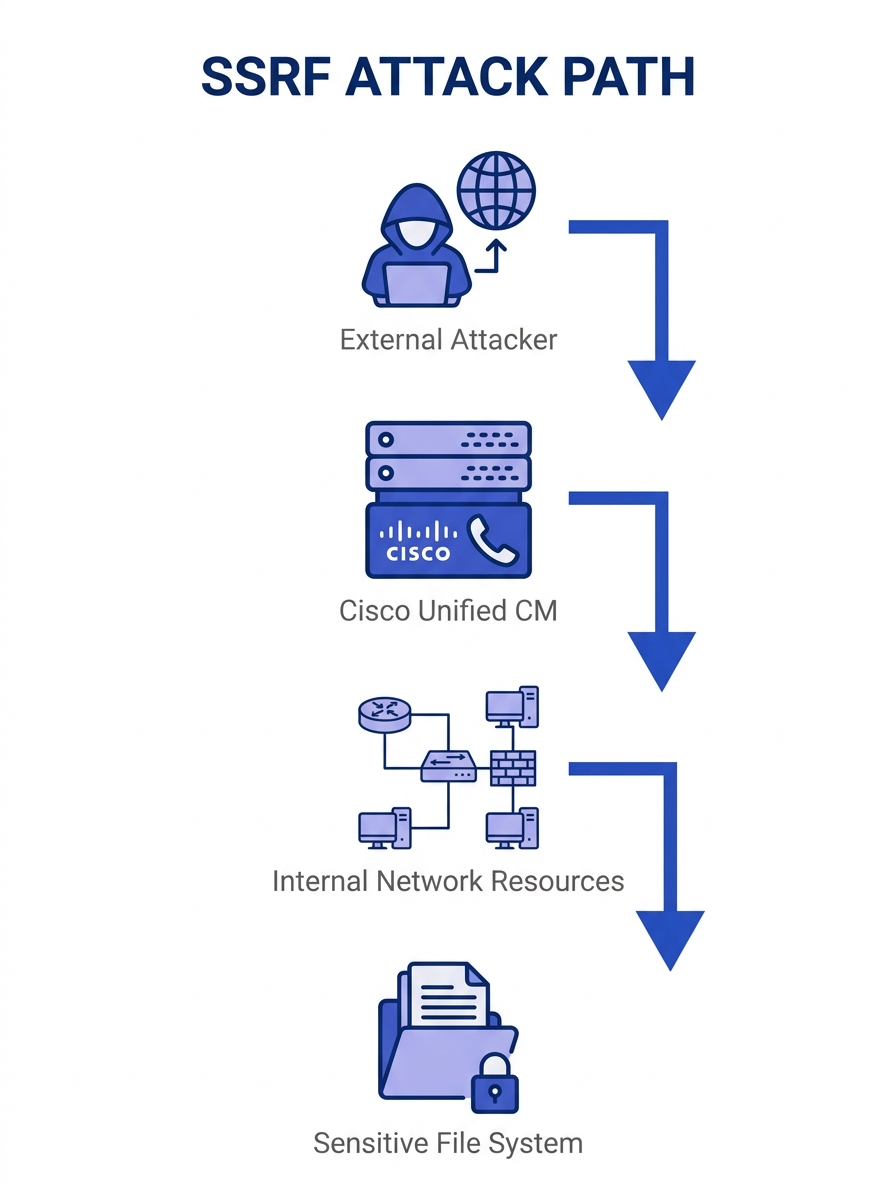
Exploitation Path and Attack Prerequisites
The attack requires zero authentication and needs only network reachability to the Cisco Unified CM or Unified CM SME management interface. The critical constraint is that WebDialer service must be enabled on the target system. WebDialer is disabled by default in Cisco Unified CM installations, reducing the immediate attack surface, but many Philippine enterprises enable the feature to support click-to-call integrations with CRM platforms, hotel property management systems, and BPO workflow tools.
Once the SSRF is triggered, the attacker coerces the vulnerable device into making requests on their behalf. The advisory confirms the SSRF can be used to write files directly to the underlying operating system. An attacker could place configuration files, shell scripts, or cron entries into system directories that execute with elevated privileges, culminating in root access. The specific file write mechanism is not detailed in the disclosure; typical SSRF-to-file-write chains exploit log injection, template rendering vulnerabilities, or backup restoration processes.
No public proof-of-concept code is circulating as of June 4, 2026, but the combination of no authentication requirement and remote exploitability makes CVE-2026-20230 a high-priority target for adversaries conducting reconnaissance against Philippine enterprise UC infrastructure. The absence of a patch at disclosure boosts risk for organizations that cannot immediately disable WebDialer without disrupting call center operations.
Impact on Philippine Enterprise UC Deployments
Cisco Unified CM anchors unified communications infrastructure at hundreds of Philippine enterprises, government agencies, BPO call centers, hospitals, and financial institutions. Metro Manila-based BPO hubs running Cisco UC platforms to integrate desk phones, Jabra headsets, and Finesse agent desktops with cloud CRM systems face immediate exposure if WebDialer is enabled for Salesforce or ServiceNow click-to-dial features. Hotel chains using Unified CM for guest room phone management and PMS integration similarly rely on WebDialer for front-desk call initiation workflows.
Root access to a Unified CM server grants an attacker control over call routing logic, dial plan configuration, SIP trunk credentials, and stored voicemail. The device can pivot into internal network segments where voice VLANs carry unencrypted RTP streams or where SIP traffic flows to downstream session border controllers. Organizations that deployed Session Border Controllers with segmented trust zones reduce lateral movement risk, but the Unified CM compromise itself remains critical because the system manages user directories, extension mappings, and call detail records.
Philippine enterprises running multi-site Unified CM clusters face compounded risk. A single compromised publisher node can propagate configuration changes across subscriber nodes in Cebu, Davao, and provincial branch offices. Organizations that implemented zero-trust network access policies for VoIP infrastructure with micro-segmentation between management, signaling, and media planes can contain the breach, but most deployments still operate flat voice VLANs inherited from legacy PBX architectures.
Mitigation Steps in the Absence of a Patch
Cisco has not released patch details or fixed software versions as of June 4, 2026. Organizations must evaluate immediate risk reduction measures. The most direct mitigation is disabling WebDialer service on all Unified CM and Unified CM SME nodes where the feature is not operationally required. IT teams can audit WebDialer enablement through the Cisco Unified CM Administration interface under System > Service Parameters > Cisco WebDialer Web Service.
For deployments where WebDialer remains necessary for CRM-to-phone integrations, perimeter firewall rules should restrict HTTP/HTTPS access to Unified CM management interfaces to trusted source IP ranges only—internal admin subnets, jump hosts, and authorized third-party integrators. Network admission control policies should prevent unauthorized devices from reaching TCP 443 and 8443 on UC servers. Organizations using Cisco Firepower or Fortinet NGFWs can deploy intrusion prevention signatures targeting HTTP request anomalies, though effectiveness depends on signature coverage for the specific CVE-2026-20230 attack pattern once researchers publish details.
Logging and monitoring become essential compensating controls. Philippine enterprises should configure Unified CM to forward syslog entries to a centralized SIEM platform (Splunk, Elastic, or Wazaa) and alert on unusual HTTP request patterns to WebDialer endpoints, unexpected file creation events in system directories (/var/log, /etc, /tmp), and privilege escalation indicators such as new cron jobs or modified sudoers files. Real-time alerting on these indicators can detect exploitation attempts before attackers achieve persistence.
Backup integrity verification is critical. Attackers who gain root access may tamper with Unified CM Disaster Recovery System (DRS) backups to hide evidence or plant backdoors in restoration archives. IT teams should validate backup hash checksums daily and store at least one immutable backup copy on write-once media or air-gapped storage.
Organizations should monitor Cisco’s security advisory portal and the CVE-2026-20230 entry for patch release announcements. When a fix becomes available, Philippine enterprises must schedule maintenance windows to apply patches across production Unified CM clusters. Standard cluster upgrade procedures require upgrading the publisher node first, then subscriber nodes, with database replication verification between each step. Planned downtime during low-call-volume windows (Sunday 2–6 AM PHT) minimizes business disruption.
Why This Matters Now
CVE-2026-20230 arrives at a moment when Philippine enterprises have consolidated voice, video, and messaging workloads onto Cisco Unified Communications Manager platforms to support hybrid work models and omnichannel contact center operations. The vulnerability exposes a single point of failure that controls thousands of SIP endpoints, hundreds of concurrent call paths, and integration touchpoints to CRM, ERP, and workforce management systems. An attacker who compromises a Unified CM server in a Metro Manila BPO call center gains visibility into client call flows, agent performance metrics, and potentially sensitive customer data stored in call recordings.
The absence of a patch forces Philippine IT operations teams into a reactive posture. Organizations cannot simply “patch and move on”; they must implement layered defenses—service disabling, network segmentation, intrusion detection, and backup hardening—while maintaining 24/7 voice availability for business-critical operations. This is the architectural challenge that securing VoIP against network-layer attacks demands: treating UC infrastructure as a high-value target requiring defense-in-depth rather than perimeter-only protection.
The disclosure also underscores the operational risk of enabling optional features like WebDialer without corresponding security hardening. Many Philippine enterprises activated WebDialer during pandemic-era digital transformation projects to integrate click-to-call into remote work CRM interfaces, but few revisited the security implications of exposing HTTP endpoints on UC call control servers to broader network access. The CVE-2026-20230 attack chain exploits exactly this gap—a convenience feature that becomes an unauthenticated entry point to root access when input validation fails. Philippine IT leaders evaluating UC platform risk in 2026 must now audit every enabled service, every exposed interface, and every trust assumption built into their voice infrastructure.