
Proprietary PBX risk compounds silently. Every month your Philippine enterprise spends inside a closed UC ecosystem, the cost of leaving that ecosystem grows. Organizations without exit strategies face switching costs 16 times higher than those that plan for portability from day one, according to enterprise cloud lock-in research.
TL;DR: UC vendor lock-in in the Philippines is worsening as AI-trained call data and proprietary integrations make switching nearly impossible after year two. Philippine enterprises in BPO, finance, and government can reduce this risk with SIP-based architectures, open standards, and contractual exit clauses. Fewer are doing so than should be.
Switching Costs Multiply in Ways Philippine Procurement Teams Don’t Model
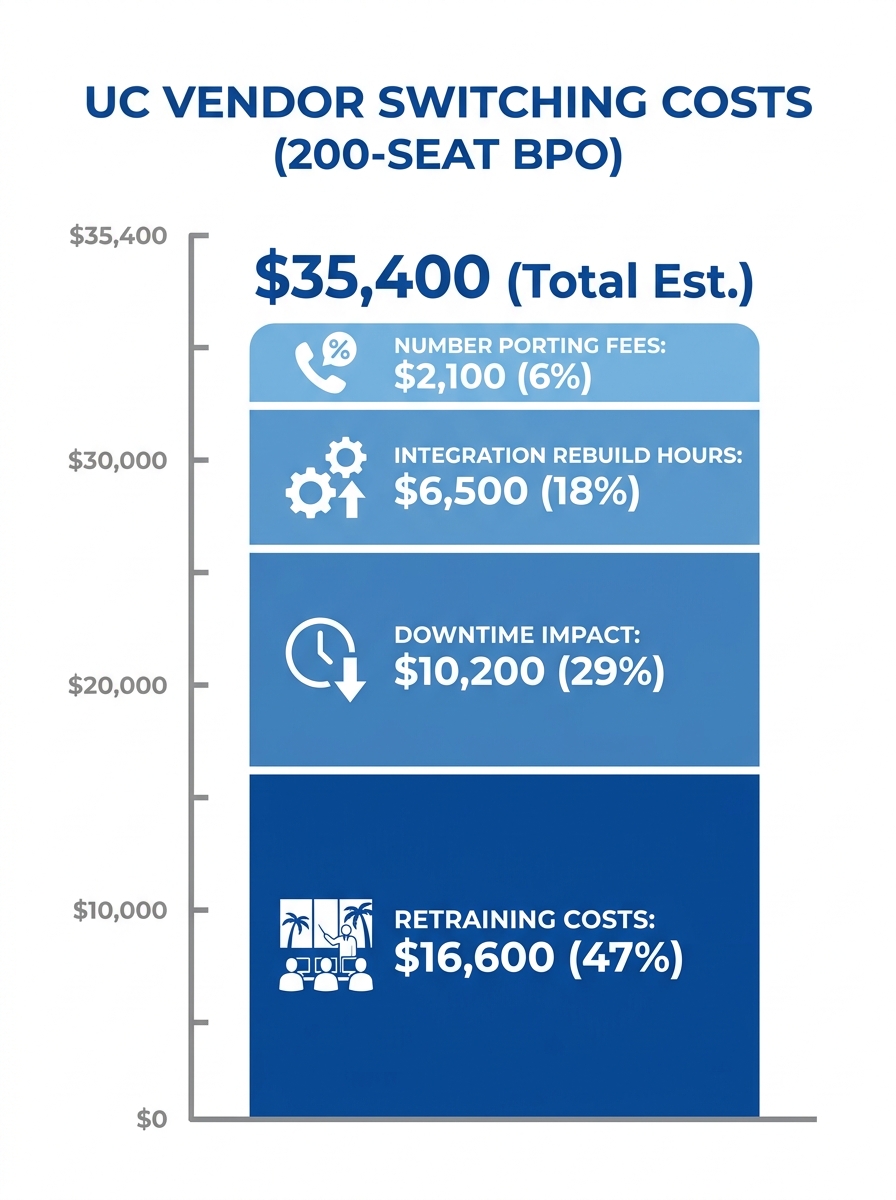
The 16x cost multiplier isn’t abstract. It reflects data migration fees, staff retraining, integration rebuilds, and downtime during cutover. For a 200-seat BPO operation in Makati running a proprietary UC suite, even a modest mid-contract exit can trigger penalties that exceed two years of service fees.
Consider the basic numbers. A cloud PBX runs roughly $19 per user per month, or about $950 monthly for a 50-person team. Hardware sits between $0 and $100 per user when you use softphones or existing devices. These costs look manageable at contract signing. The problem shows up 30 months later when the vendor raises per-seat pricing by 8.8% annually, matching the SaaS-wide average from 2023. Some vendors pushed increases above 20%.
Number porting adds another layer. Moving your existing phone numbers to a new system costs $5 to $25 per number. A hospital chain with 12 branches and hundreds of DIDs across Metro Manila, Cebu, and Davao can face porting bills in the tens of thousands of pesos before a single call routes through the new platform.
Philippine BPO call centers carry the heaviest exposure. Their UC platforms handle call recording, quality assurance scoring, workforce management, and CRM integration. Every one of those connections is a thread that must be rebuilt, retested, and revalidated during migration. A phased rollout across shifts can take six to eight weeks. That timeline assumes everything goes according to plan, which it rarely does when you’re planning a PBX consolidation across multiple sites.
And 32% of cloud spend is already wasted due to poor cost control and lock-in. That waste tends to grow, not shrink, as organizations add modules and seats to their existing vendor’s platform over time.
AI Training Data Becomes the Deepest Lock
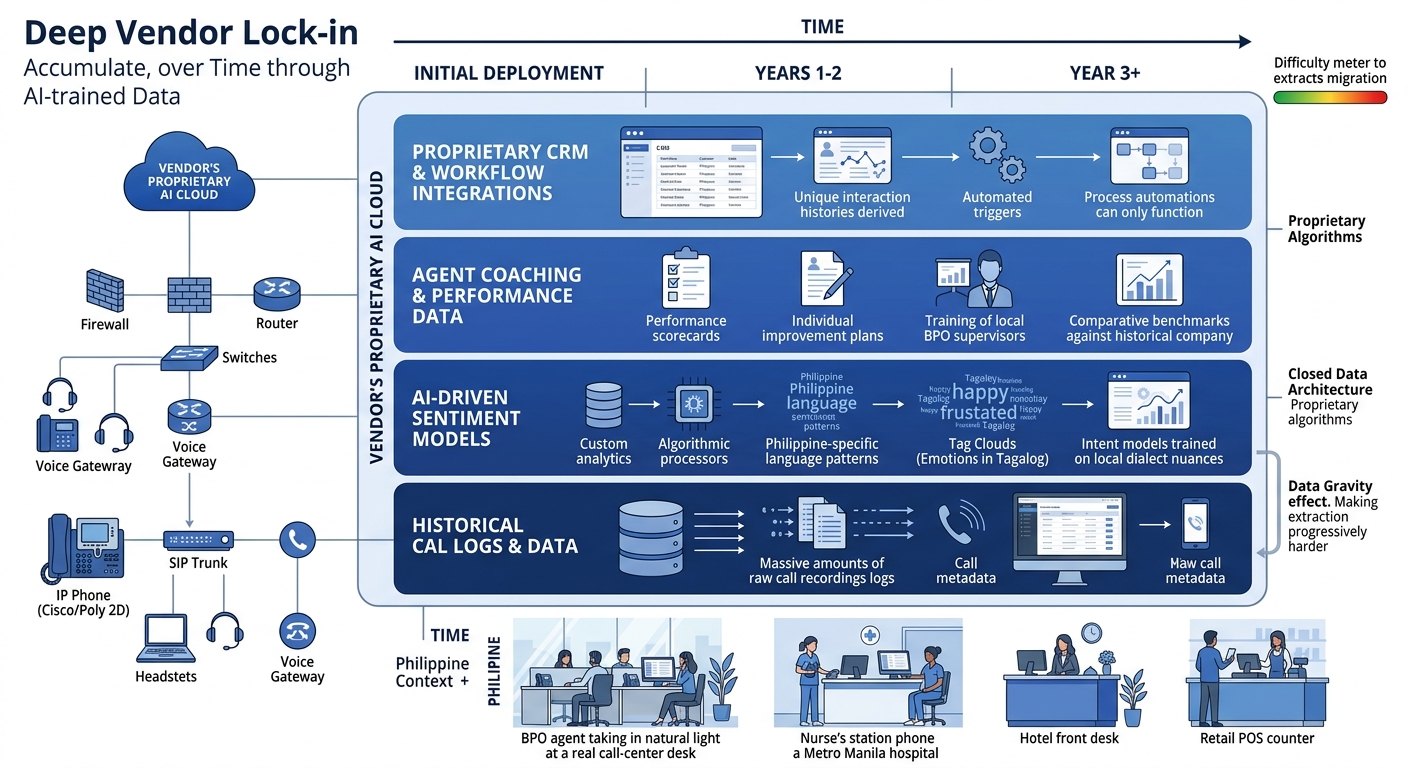
The UC vendor lock-in problem in the Philippines is growing worse for a specific reason: AI. As organizations feed call recordings, transcripts, sentiment scores, and agent performance data into their UC vendor’s AI tools, they create a body of operational intelligence that belongs to the platform, not to them.
NoJitter’s analysis of AI-driven UC lock-in put this bluntly: switching platforms used to mean losing features and retraining staff. Now it means “losing operational intelligence” built over months or years of AI model training. The call patterns, customer sentiment baselines, and agent coaching insights your AI assistant learned from 18 months of live calls don’t transfer to a competing platform. You start from zero.
This matters enormously for Philippine enterprises investing in AI-powered call intelligence. A Quezon City-based insurance firm that trained its UC platform’s AI on 400,000 recorded customer interactions now has a model that understands Tagalog-English code-switching, regional accents, and product-specific terminology. That trained model lives inside the vendor’s cloud. Moving to a different UC provider means abandoning that intelligence and starting the training cycle over.
Warning: If your UC vendor’s AI tools are processing call recordings, transcripts, or sentiment data, ask one question before your next renewal: can you export the trained model or its outputs in a portable format? If the answer is no, your lock-in deepens with every call.
Microsoft Teams lock-in follows this pattern exactly. Teams integrates with Copilot, Power Automate, SharePoint, and Dynamics 365. Each integration adds value. Each integration also adds a dependency that makes leaving Microsoft’s ecosystem more painful. As NoJitter’s reporting noted, this creates “strategic risks for IT leaders, who must consider not only costs but a potential loss of agility.”
The 86% of enterprises now operating in multi-cloud environments are responding to exactly this risk. They spread workloads across providers so no single vendor holds all their operational data. But UC platforms resist this pattern. Voice, video, messaging, and AI analytics typically live in one vendor’s stack, and that’s by design.
Open Standards for UC in the Philippines Exist, But Adoption Lags
The Unified Communications Interoperability Forum (UCIF) was founded specifically to address this problem. HP, Juniper Networks, Microsoft, Polycom, and Logitech/LifeSize created the non-profit alliance to build interoperability profiles, testing guidelines, and best practices for cross-vendor UC systems.
Nick Hawkins, then director of technology consulting for Asia-Pacific at Polycom, told ZDNet that the forum aimed to “drive open standards and interoperability among UC systems.” The UCIF published implementation guidelines and tested unified communications interoperability across member platforms.
Yet most Philippine enterprises still procure UC systems without requiring open standards compliance. Government agencies evaluating secure communication infrastructure often default to whatever Microsoft or Cisco bundle their existing IT integrator offers. The selection process optimizes for speed of deployment, not for long-term portability. CTO Cloud Philippines warned directly that lock-in risks are “a warning for both Philippine enterprises and government agencies that rely on global cloud platforms for sensitive operations and national data.”
Open standards for UC in the Philippines have real alternatives behind them. Rocket.Chat’s enterprise tier costs roughly $4 per user per month and supports self-hosting, full data ownership, and API-based integration. Nextcloud Talk provides an open-source collaboration stack with video, chat, and file sharing. Commercial self-hosted options like TrueConf and Secumeet offer deployment flexibility in exchange for licensing fees. None of these replicate every feature of Microsoft Teams or Cisco Webex. But they eliminate the proprietary data trap.
| Platform | Monthly Cost (per user) | Self-Hosted Option | Data Portability | AI Integration |
|---|---|---|---|---|
| Microsoft Teams | $6–$57 (M365 bundle) | No | Limited (vendor cloud) | Copilot (proprietary) |
| Cisco Webex | $14–$25 | Partial (hybrid) | Moderate (API export) | Webex AI (proprietary) |
| Rocket.Chat Enterprise | ~$4 | Yes (full) | Full (open format) | Pluggable (open API) |
| Nextcloud Talk | Free (self-hosted) | Yes (full) | Full (open format) | Community plugins |
| TrueConf Server | License-based | Yes (full) | Full (local storage) | Limited |
The comparison reveals a pattern. Open-source and self-hosted platforms trade feature depth for data control. For Philippine enterprises where regulatory compliance under the Data Privacy Act of 2012 matters (banks, hospitals, government agencies), that trade-off deserves serious evaluation. You can review our comparison of on-premise PBX and cloud VoIP costs for a deeper look at how these numbers play out across five-year ownership periods.
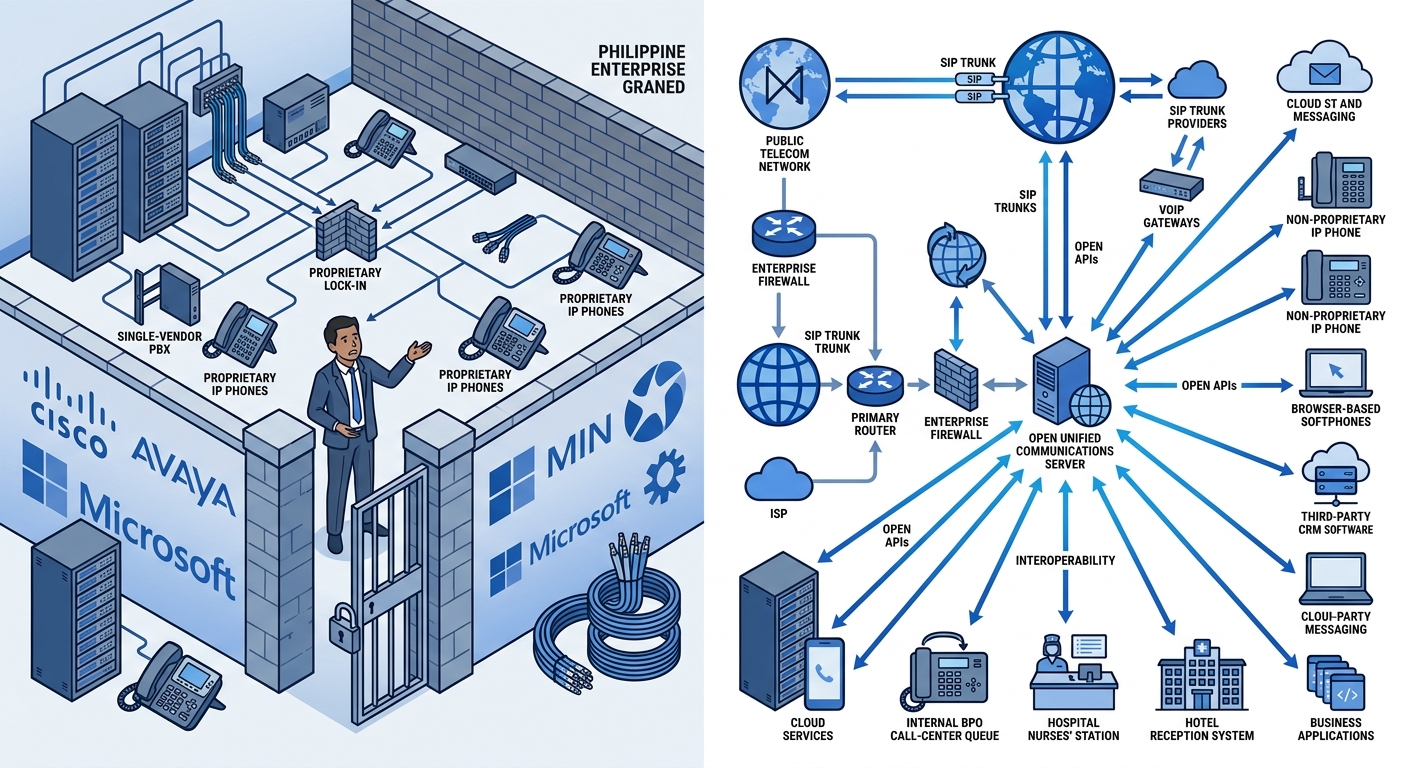
SIP trunking is the foundational layer here. Enterprises that deploy SIP-based voice infrastructure with proper failover configuration retain the ability to swap UC front-ends without rebuilding their entire voice network. The trunk carries the calls. The application layer on top can change. That separation is exactly what proprietary UC bundles are designed to prevent.
Every month your enterprise spends inside a closed UC ecosystem, the cost of leaving that ecosystem grows. The lock deepens with every AI model trained, every integration built, every workflow automated inside a single vendor’s cloud.
Where This Leaves Philippine UC Procurement
The claim here is straightforward: proprietary PBX risk is the single largest unmanaged liability in Philippine enterprise communications, and it’s getting worse as AI embeds deeper into UC platforms. Three threads of evidence support that claim. Switching costs multiply to 16 times the planned amount when organizations skip exit planning. AI-trained operational data creates a new category of lock-in that didn’t exist three years ago. And open-standards alternatives sit available but unused because procurement teams optimize for deployment speed over long-term flexibility.
Philippine enterprises that run multi-cloud strategies for their application workloads already understand architectural independence as a business continuity principle. The same logic applies to UC. Your voice, video, messaging, and AI analytics stack should be portable. Your call recordings and trained models should be exportable. Your contracts should include capped renewal increases, data migration assistance, and clearly defined exit terms.
None of this requires abandoning Microsoft Teams or Cisco Webex today. It requires negotiating contracts that assume you might leave tomorrow. It requires choosing SIP-based voice layers that don’t depend on a single vendor’s application server. And it requires asking your UC vendor one question every renewal cycle: if we leave in 12 months, what do we keep and what do we lose? The answer to that question defines your actual lock-in exposure, and most Philippine enterprises have never asked it.