
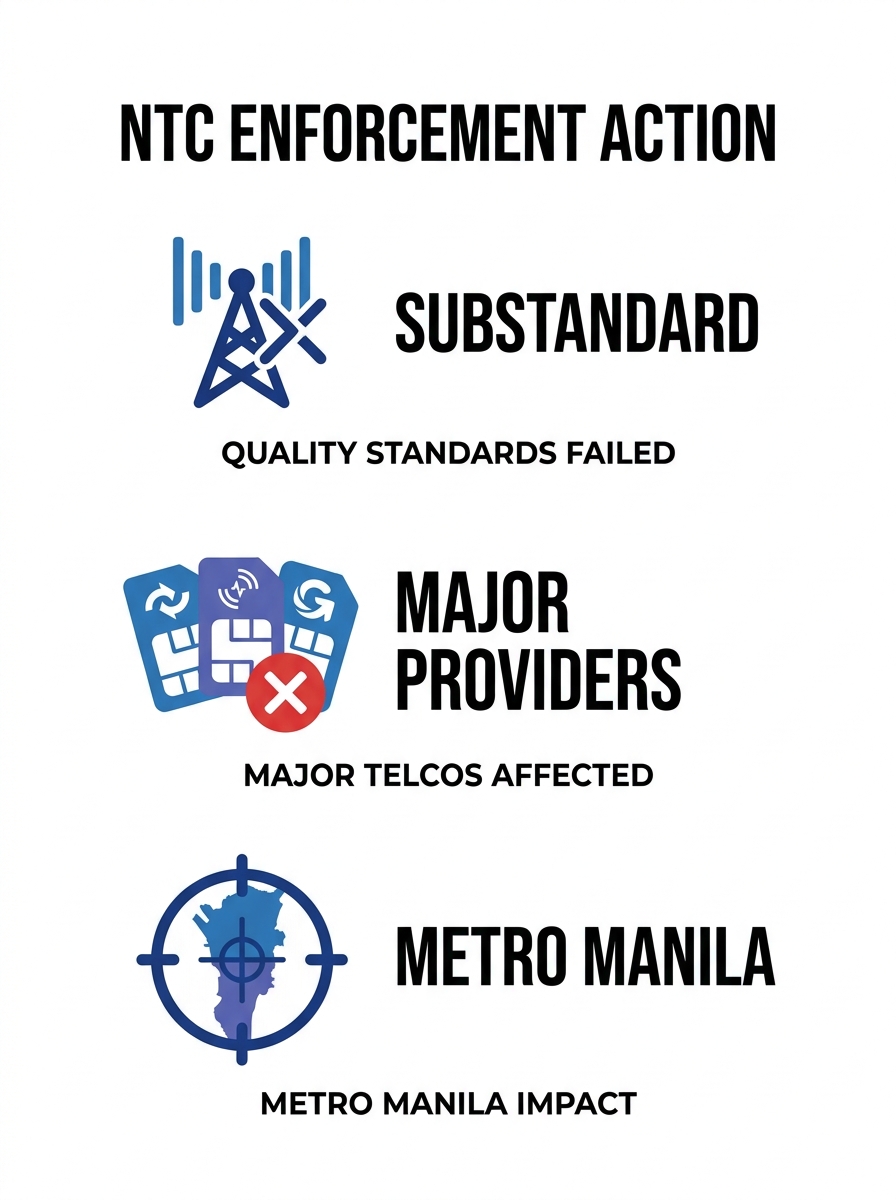
The National Telecommunications Commission imposed ₱100,000 daily fines on Globe Telecom, Smart Communications, and DITO Telecommunity starting September 25, 2026, for substandard mobile internet service in Metro Manila, according to Technobaboy. The penalties will remain in effect until service quality improves in the affected areas.
TL;DR: NTC fined three major telcos ₱100,000 per day each beginning September 25 for poor mobile broadband performance in specific Metro Manila cities, backed by Commonwealth Act No. 146 as amended by Republic Act No. 11659.
The enforcement action follows September 2026 quality tests that showed degraded network performance compared to earlier quarters, despite assurances from the carriers. NTC found slow data speeds and poor coverage across multiple cities in the National Capital Region.
Test Results Flag Specific Cities for Each Carrier
Globe Telecom was cited for service failures in Manila, Makati, and Quezon City. DITO Telecommunity received penalties for poor performance in San Juan, Pasay, and Las Piñas. Smart Communications was flagged for inadequate service in Parañaque, Manila, and Pasig.
The regulator conducted field measurements in September that revealed performance below acceptable thresholds. NTC did not disclose specific speed test figures or benchmark criteria in its public announcement, but indicated that results fell short of commitments made by the operators following earlier warnings.
Legal Authority Backs Enforcement Action
The fines draw authority from Section 17(a) of Commonwealth Act No. 146, as amended by Republic Act No. 11659. This provision grants NTC the power to enforce service quality standards and penalize operators that fail to comply with regulatory requirements.
Each telco faces a separate ₱100,000 daily penalty, meaning the three carriers collectively incur ₱300,000 in fines each day until service improvements meet NTC standards. The regulator set no deadline for compliance, leaving the penalty period open-ended based on actual network performance.
Bi-Weekly Retests to Monitor Compliance
NTC will conduct bi-weekly retests in the cited areas to verify whether carriers have restored service quality. The agency stated it will continue monitoring mobile broadband performance across Metro Manila beyond the initially flagged cities.
The enforcement mechanism places pressure on operators to prioritize infrastructure investments and network optimization in the affected zones. For carriers, the daily penalty structure creates direct financial incentive to resolve congestion, equipment failures, or capacity constraints that degrade user experience.
Implications for Enterprise Network Planning
The enforcement action signals heightened regulatory scrutiny of carrier service-level performance, a factor that directly affects enterprise connectivity decisions. Organizations evaluating mobile connectivity for distributed teams, field operations, or backup WAN circuits now face documented evidence of quality variance by carrier and by location within Metro Manila.
IT managers planning network security solutions and connectivity architecture may need to reassess carrier diversity strategies, particularly for operations spanning the eight cities cited in the NTC action. The enforcement also raises questions about service-level agreement enforceability when telco performance falls below advertised speeds.
For BPO call centers, hospitals, hotels, and government agencies that rely on mobile broadband for backup links or primary connectivity in remote sites, the fines underscore the importance of carrier performance verification before deploying critical workloads. The NTC’s bi-weekly retest schedule provides a public accountability mechanism that enterprise buyers can reference when negotiating contracts or escalating performance issues.
The regulator’s decision to publish city-level performance failures creates transparency that was previously unavailable to business customers. Enterprise procurement teams can now cross-reference NTC findings against their own site locations when evaluating carrier proposals for new branches or expansion projects.
Reading Between the Lines
The ₱100,000 daily fine per carrier may seem modest against the revenue scales of Globe, Smart, and DITO, but the open-ended penalty structure and public disclosure of specific failure zones create reputational and competitive pressure that extends beyond the direct financial cost. For enterprises, this enforcement action provides a rare regulatory validation of service quality concerns that IT teams have raised internally for months.
The NTC’s willingness to cite all three major carriers simultaneously, rather than singling out a laggard, suggests systemic infrastructure strain across Metro Manila’s mobile networks. This points to capacity planning challenges that affect enterprise users as much as consumer subscribers. Organizations should expect continued quality volatility in the cited areas until carriers complete infrastructure upgrades, a timeline the regulator has left deliberately undefined.
The bi-weekly retest cadence also establishes a precedent for ongoing regulatory oversight that could extend to other regions if NCR quality improvements do not materialize. For IT decision-makers, the enforcement action reinforces the need for carrier-diverse connectivity strategies and performance monitoring that does not rely solely on vendor-reported metrics.