
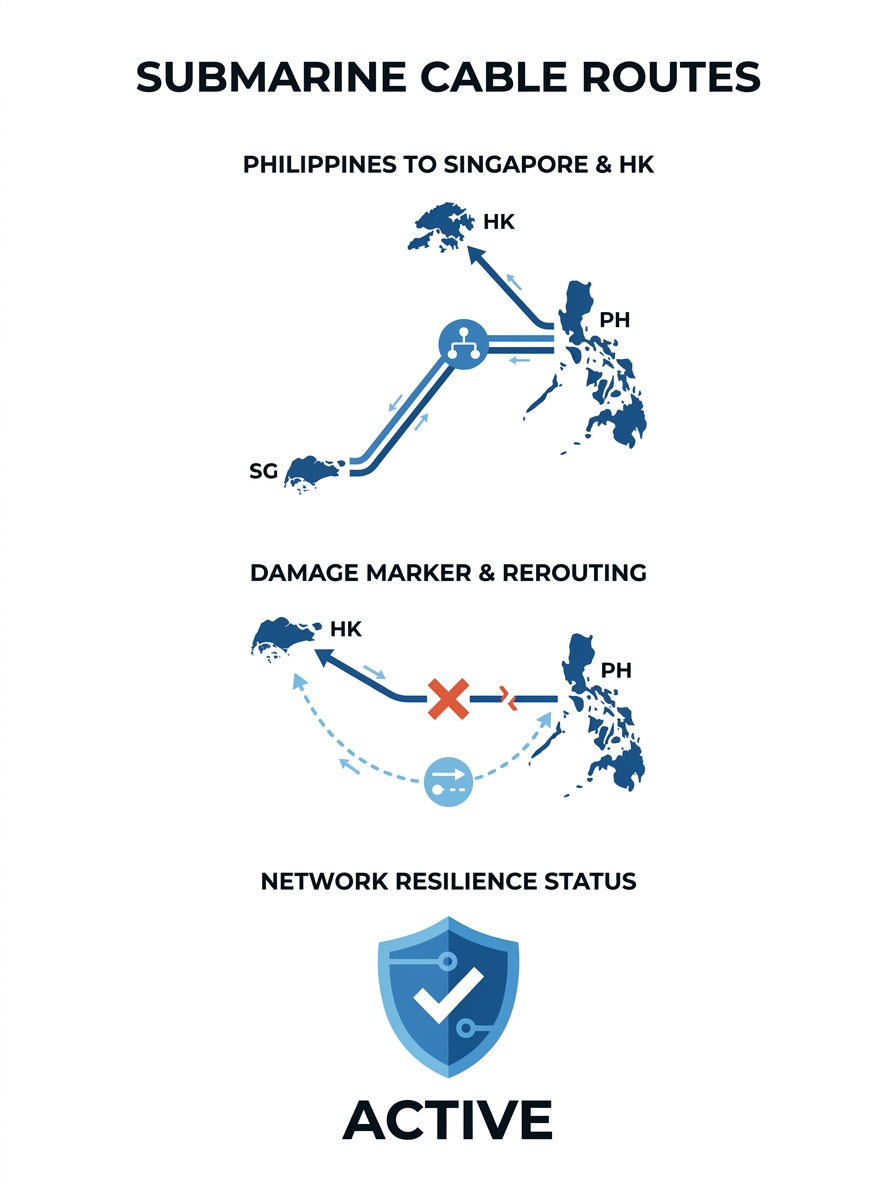
Damage to submarine cables connecting the Philippines to Singapore and Hong Kong on October 2 forced Globe Telecom, PLDT, and Converge ICT Solutions to reroute international traffic, resulting in slower speeds and higher latency for enterprise and residential users nationwide, according to advisories from the three carriers. PLDT confirmed a 300Gbps capacity loss on the affected links.
TL;DR: Submarine cable damage on October 2 disrupted Philippine internet access via Singapore and Hong Kong routes, forcing major carriers to reroute traffic and causing slower speeds nationwide while repairs proceed over the coming weeks.
The incident reduced available international bandwidth across all three carriers, triggering service degradation for customers accessing sites and cloud services hosted outside the Philippines. PADECO, Converge, and UP Diliman issued advisories confirming offshore connections were most affected.
Carriers Activate Backup Routes to Maintain Service
Globe Telecom initiated traffic rerouting Thursday night and warned subscribers repairs could take weeks. The carrier shifted traffic to alternative submarine cable systems to maintain connectivity despite reduced capacity on the Singapore and Hong Kong links.
PLDT confirmed the 300Gbps capacity loss but assured subscribers it maintains sufficient redundant capacity to cover the disruption. The carrier rerouted traffic through other international cable landing points to minimize service impact.
Converge ICT Solutions also shifted traffic to backup submarine cable pipelines and continues monitoring network stability. The carrier has not disclosed specific capacity figures but confirmed alternative routes are handling diverted traffic.
Impact on Business Operations and Cloud Access
The reduced bandwidth caused slower download and upload speeds, increased latency, and intermittent access to international websites and cloud platforms. Enterprises relying on Singapore and Hong Kong data centers for hosted applications experienced degraded performance during business hours on October 2 and 3.
Schools and educational institutions including UP Diliman warned students and faculty of possible connectivity issues affecting online learning platforms and research resources hosted abroad. BPO operations serving international clients reported latency spikes during peak traffic periods.
The disruption primarily affected traffic to and from Southeast Asian and East Asian destinations. Domestic Philippine internet traffic and local cloud services hosted within the country remained unaffected by the submarine cable damage.
Investigation and Repair Timeline
Department of Information and Communications Technology Secretary Henry Aguda said possible causes include fiber cuts, equipment failure, or sabotage, but stressed the investigation is ongoing. DICT is coordinating with the affected carriers and international cable consortium partners to determine the exact cause and location of the damage.
Submarine cable repairs typically require specialized cable-laying vessels to locate the damaged section, retrieve the cable from the ocean floor, splice in replacement segments, and re-lay the repaired cable. This process can take two to four weeks depending on water depth, weather conditions, and vessel availability.
Globe’s advisory indicated repairs could extend several weeks. Neither PLDT nor Converge provided specific repair completion estimates, noting the timeline depends on damage assessment results and repair vessel scheduling.
The incident follows recent National Telecommunications Commission penalties against major carriers for mobile internet quality issues in Metro Manila, though the submarine cable damage is unrelated to the domestic network performance concerns that triggered those fines.
What This Means for IT Managers
Philippine enterprises should review their internet connectivity architecture and international bandwidth dependencies immediately. Organizations relying on single-carrier connections to Singapore or Hong Kong for cloud access, backup replication, or branch office connectivity face extended exposure to degraded performance until repairs complete in late October or early November.
IT operations teams should audit which critical applications route through the affected cable systems and implement temporary traffic prioritization for business-essential services. Contact your carrier account manager for specific rerouting details and expected performance levels during the repair window. Organizations with multi-carrier contracts should verify their backup circuits are routing through unaffected cable systems rather than sharing the damaged infrastructure.
This disruption demonstrates the importance of diverse international connectivity for Philippine businesses. Evaluate whether your current data center solutions and network architecture include geographic redundancy across multiple submarine cable landing points. Consider hybrid connectivity strategies that distribute critical workloads across domestic Philippine data centers and international cloud regions connected via different cable routes.