
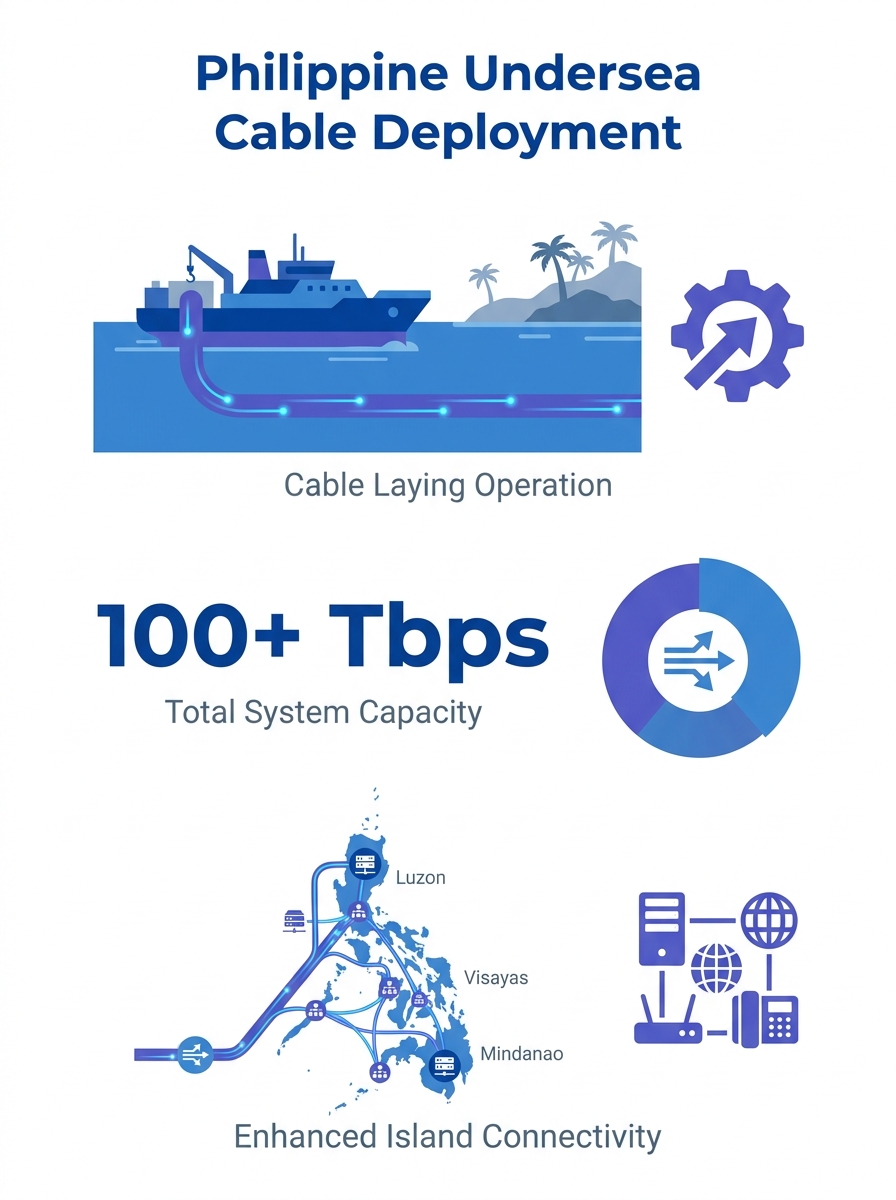
Globe Telecom, PLDT, and Converge ICT Solutions have jointly proposed a $500-million (approximately P30.63-billion) nationwide undersea fiber-optic network spanning Batanes to Palawan with extensions to the Visayas and Mindanao, according to Department of Information and Communications Technology Secretary Henry Rhoel R. Aguda, who disclosed the plan during a roundtable briefing last week as reported by BusinessWorld.
The DICT is currently evaluating the consortium proposal, which remains subject to government approval before implementation can begin. The three telecommunications providers are positioning the project as a complement to the government’s National Fiber Backbone initiative, with completion targeted within two years once authorized.
TL;DR: Three Philippine telcos proposed a P30.63-billion undersea fiber network connecting Batanes to Mindanao, featuring seismic detection capabilities and integration with international cable systems, pending DICT approval for a two-year build-out.
Network Scope and Infrastructure Design
The proposed network would deploy undersea fiber-optic cables as the primary transmission medium rather than traditional terrestrial lines, connecting islands and areas currently lacking telecommunications service. “There is a proposal from Globe, PLDT, and Converge to fiberize the whole country using undersea cable,” Aguda told reporters, describing the geographic scope as extending from the northernmost province of Batanes to Palawan in the west, with dedicated links reaching the Visayas and Mindanao regions.
The undersea cable approach addresses longstanding connectivity gaps in archipelagic areas where land-based infrastructure deployment faces geographical and cost barriers. The DICT has not disclosed specific route maps or the number of landing stations required, but the project’s scale suggests multiple connection points across the 7,641-island nation.
Philippine data center capacity expansion has accelerated demand for backbone connectivity infrastructure, as facilities require redundant high-capacity links to international cable systems and domestic endpoints.
Technology and Strategic Benefits
The planned network incorporates digital acoustic sensor technology embedded within the fiber-optic cables, enabling real-time seismic activity detection. “The benefit of this fiber optic cable is it has the digital acoustic system, which allows cable to detect seismic movements for earthquake, tsunami,” Aguda said, noting that the infrastructure would serve dual civilian and national security purposes through continuous data collection.
The seismic monitoring capability positions the telecommunications infrastructure as a distributed sensor network for the Philippine Institute of Volcanology and Seismology and disaster preparedness agencies. The technology transmits vibration data through the same fiber strands carrying communications traffic, requiring no additional hardware beyond the cable system itself.
Aguda emphasized the collaborative nature of the proposal, stating, “What’s good about this proposal is that this is being pushed by these three telcos, I think (they are a consortium).” The DICT has not confirmed whether the three companies would operate as a formal joint venture or maintain separate ownership stakes in different network segments.
Timeline and Approval Process
The two-year construction timeline would begin once the DICT and relevant government agencies complete their evaluation and grant final approval. The department has not specified which regulatory hurdles the proposal must clear, though Aguda indicated interagency collaboration would be necessary because the project is designed as a domestic network.
The proposed undersea system would complement the National Fiber Backbone program, which aims to deliver high-speed fiber-optic infrastructure across the country. In May, the DICT announced it was fast-tracking Phases 4 and 5 of that initiative, with completion scheduled within 2026. The National Fiber Backbone project is expected to benefit approximately 70 million Filipinos through faster and more reliable internet connectivity.
“For the foreign points, what we planned to do is, because we have 14 international points of presence, we planned to connect all these landing stations,” Aguda said, describing how the domestic undersea network would integrate with international connectivity infrastructure.
International Cable Integration
The consortium members already participate in separate international submarine cable systems, providing existing expertise in undersea infrastructure deployment and operations. Globe Telecom joined the Candle Cable System consortium in April 2026, strengthening the Philippines’ digital backbone through connections to submarine cable networks across Asia.
PLDT has invested in the Apricot cable system, a 12,000-kilometer undersea fiber-optic network providing direct connectivity between Singapore and Japan. Converge participates in the Bifrost and Southeast Asia Hainan-Hong Kong Express Cable System (SEA-H2X) international cable initiatives.
The proposed domestic network would connect to these international systems through the 14 points of presence Aguda referenced, creating redundant paths for international traffic and reducing dependence on single cable routes that have historically created vulnerability during cable breaks or natural disasters.
The PLDT-DITO infrastructure-sharing agreement signed earlier this year established precedent for inter-carrier collaboration on physical infrastructure, though that arrangement focused on terrestrial tower and site sharing rather than submarine cable deployment.
Government Implications
The P30.63-billion private-sector proposal arrives as government agencies face mounting pressure to close connectivity gaps that impede digital service delivery to remote and island communities. The Executive Order 119 data residency requirements mandate that Top Secret and Secret information remain stored within Philippine territory, creating demand for robust domestic backbone infrastructure that can support geographically distributed government data centers without routing traffic through international cable systems.
National defense and disaster response capabilities would gain real-time seismic monitoring across submarine cable routes, supplementing existing land-based sensor networks operated by PHIVOLCS and the Office of Civil Defense. The acoustic detection system embedded in telecommunications cables provides continuous coverage in waters where dedicated oceanographic sensor deployments face maintenance and power supply challenges.
Government IT infrastructure planners evaluating multi-year network roadmaps should monitor the DICT approval timeline, as the undersea network would create new redundancy options for agencies operating facilities in Visayas and Mindanao regions currently served by limited terrestrial fiber routes. The two-year construction period suggests operational capacity would arrive in 2028 or 2029, aligning with national connectivity targets tied to the Philippine Development Plan’s digital transformation objectives.