
Cisco assigned a Critical Security Impact Rating to CVE-2026-20230, a server-side request forgery vulnerability in Unified Communications Manager, overriding the flaw’s 8.6 CVSS base score due to the potential for unauthenticated attackers to escalate privileges to root level, according to a security advisory published June 5, 2026. The vulnerability affects Cisco Unified CM and Unified CM Session Management Edition but is only exploitable when the WebDialer service is enabled.
TL;DR: Cisco elevated CVE-2026-20230 from High to Critical severity because the SSRF flaw enables unauthenticated attackers to write arbitrary files and gain root access on Unified Communications Manager systems running WebDialer.
The discrepancy between Cisco’s internal Security Impact Rating and the Common Vulnerability Scoring System assessment reflects the vendor’s evaluation of ultimate impact rather than initial entry method. While an 8.6 CVSS score typically falls into the High severity category, Cisco Product Security Incident Response Team determined that successful exploitation results in complete system compromise. Philippine enterprises and government agencies running Cisco Unified CM for core telephony infrastructure should treat this as a priority remediation item regardless of the numerical score.
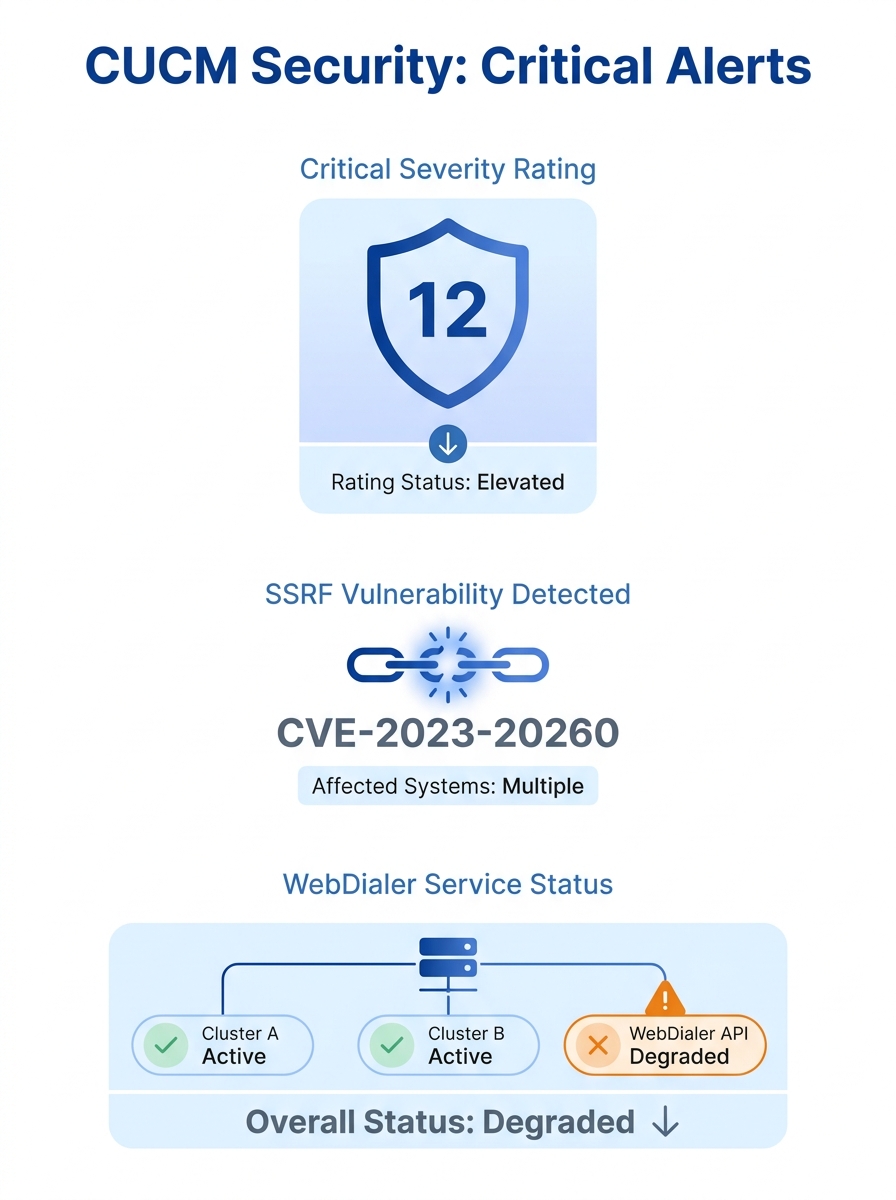
Root Escalation Mechanism Drives Critical Rating
Cisco’s Security Impact Rating methodology evaluates the end-state risk of exploitation, not just the initial vulnerability class. The company stated in the advisory that “exploitation of this vulnerability could result in an attacker elevating privileges to root,” which represents total system control. The SSRF flaw allows attackers to trick the Unified CM server into making HTTP requests on its behalf, but the critical element is the ability to write arbitrary files to the underlying operating system.
Writing arbitrary files enables attackers to overwrite configuration files, inject SSH authorized keys, or modify scheduled tasks to establish persistent root-level access. For Philippine government agencies and enterprises running Unified CM as the central call-routing platform for multi-site deployments, root access to the communications manager provides visibility into call routing, recording capabilities, and potential lateral movement to connected voice infrastructure. This escalation path transforms a web-based input validation flaw into a systemic infrastructure compromise vector.
The vulnerability stems from improper input validation for specific HTTP requests within Cisco Unified CM and Unified CM Session Management Edition. An independent security researcher working with SSD Secure Disclosure discovered and reported the flaw, according to Cisco PSIRT. The researcher identified the complex escalation path from SSRF to root before the vulnerability could be weaponized by threat actors in production environments.
WebDialer Dependency Limits Exposure Surface
The vulnerability is only exploitable if the Cisco WebDialer Web Service is enabled on the target system. WebDialer is disabled by default in standard Unified CM installations, providing automatic protection for most deployments that have not specifically activated the feature. Philippine enterprises that have never enabled WebDialer for browser-based click-to-dial functionality are not exposed to this attack vector.
Organizations can verify WebDialer status and disable the service through the Cisco Unified CM Administration interface. Administrators should log in, navigate to Cisco Unified Serviceability through the Navigation menu, access Service Activation under the Tools menu, and locate the CTI Services section. If the Cisco WebDialer Web Service checkbox is marked, the service is active and the system is vulnerable. Unchecking the box and clicking Save disables the service immediately.
This mitigation step is temporary, not a permanent fix. Disabling WebDialer eliminates the attack surface for CVE-2026-20230 but does not patch the underlying input validation flaw. Organizations that require WebDialer functionality for business operations must transition to fixed software releases rather than relying on service deactivation as a long-term security posture. Metro Manila call centers and BPO facilities that use WebDialer for agent-initiated outbound dialing should coordinate mitigation timing with operational requirements.
Public Proof-of-Concept Code Narrows Response Window
Cisco PSIRT confirmed that proof-of-concept exploit code for CVE-2026-20230 is publicly available, lowering the technical barrier for threat actors to develop working exploits. The company stated it is not currently aware of malicious use in the wild, but public PoC availability typically accelerates the timeline from vulnerability disclosure to active exploitation. Philippine organizations running exposed Unified CM systems should assume adversaries have access to working exploit techniques.
The availability of public PoC code shifts the vulnerability from a theoretical risk to an operationally testable attack. Security teams at Philippine enterprises can use the published research to validate their own exposure through controlled testing in lab environments, but the same code enables less sophisticated attackers to target production systems. Organizations that cannot immediately deploy patches should implement compensating controls including network security solutions that monitor for anomalous HTTP requests to Unified CM web interfaces and unusual file system modifications on communications servers.
For enterprises already affected by previous Cisco Unified CM vulnerabilities, this advisory reinforces the need for defense-in-depth strategies beyond vendor patching cycles. Organizations should review existing zero-trust network access policies for VoIP infrastructure to ensure that communications managers are not directly accessible from untrusted network segments.
Fixed Releases Available for Version 14, September Timeline for Version 15
Cisco has released Unified CM 14SU6 as the first fixed version for systems running version 14.x. Organizations on Unified CM 15.x can upgrade to 15SU5 when it becomes available in September 2026, or deploy a Cisco Options Package (COP) file immediately for interim protection. The COP file provides a specialized patch for version 15 systems that cannot wait for the full Service Update scheduled for Q3 2026.
Philippine government agencies and enterprises should prioritize systems with WebDialer enabled for immediate patching. Organizations running Unified CM 14.x can deploy the 14SU6 update according to standard change management procedures. Version 15.x environments face a decision between deploying the COP file for immediate mitigation or scheduling the 15SU5 upgrade for September. The COP file approach allows faster deployment but requires validation that the targeted patch does not conflict with existing system configurations.
Multi-site deployments common in Philippine banking and retail sectors should stagger patching across geographically distributed Unified CM clusters to maintain service continuity during the upgrade window. The Cisco Unified CM SSRF vulnerability demonstrates the risks of delayed patching on core infrastructure components that serve as single points of failure for enterprise voice systems.
Government Implications
Philippine government agencies running Cisco Unified CM for inter-agency voice communications and emergency services coordination should treat CVE-2026-20230 as a critical infrastructure vulnerability regardless of whether WebDialer is currently enabled. The root access potential transforms a communications platform compromise into a broader security incident with implications for data sovereignty and government network segmentation.
The NTC and DICT should consider issuing guidance on Unified CM patching timelines for government voice infrastructure, particularly for agencies that interconnect with public safety answering points or operate classified communications systems. The vulnerability’s reliance on WebDialer provides temporary protection, but the underlying input validation flaw represents a design weakness that could resurface in related Cisco services if left unpatched.
Government IT managers should validate that Unified CM systems are isolated from public internet access and protected by inspection-capable firewalls that can detect SSRF attack patterns. Agencies that cannot immediately deploy patches due to change freeze windows or vendor support constraints should document the specific risk acceptance, implement compensating network controls, and establish monitoring for suspicious HTTP requests targeting WebDialer endpoints. The September 2026 timeline for version 15 fixes gives agencies running that release three months to plan maintenance windows, but organizations with active WebDialer deployments should prioritize the COP file option for immediate mitigation.