
Philippine enterprises lose connectivity, voice systems, and access to critical applications within the first 6 to 12 hours of a major typhoon landfall, and most disaster recovery plans written for these exact scenarios have never been validated under the conditions they describe. The gap between documented RTO and actual RTO failure in Philippine operations widens every season.
TL;DR: DR plans fail during real typhoons because they’re tested in ideal conditions, funded with paper allocations instead of cash, dependent on single-carrier telecom links, and written as if typhoons only break one system at a time. These six rules address the specific gaps that turn a documented 4-hour RTO into a 72-hour outage.
The six rules below target disaster recovery Philippines typhoon planning at the enterprise level. Each one addresses a documented failure pattern from the 2024 cyclone season and earlier events, drawn from ILO assessments, Commission on Audit findings, and field reports from PDRF’s network coordination. If your DR plan hasn’t been updated since its last tabletop exercise, at least one of these rules describes why it will fail.
Test your failover under degraded power, not from a climate-controlled server room
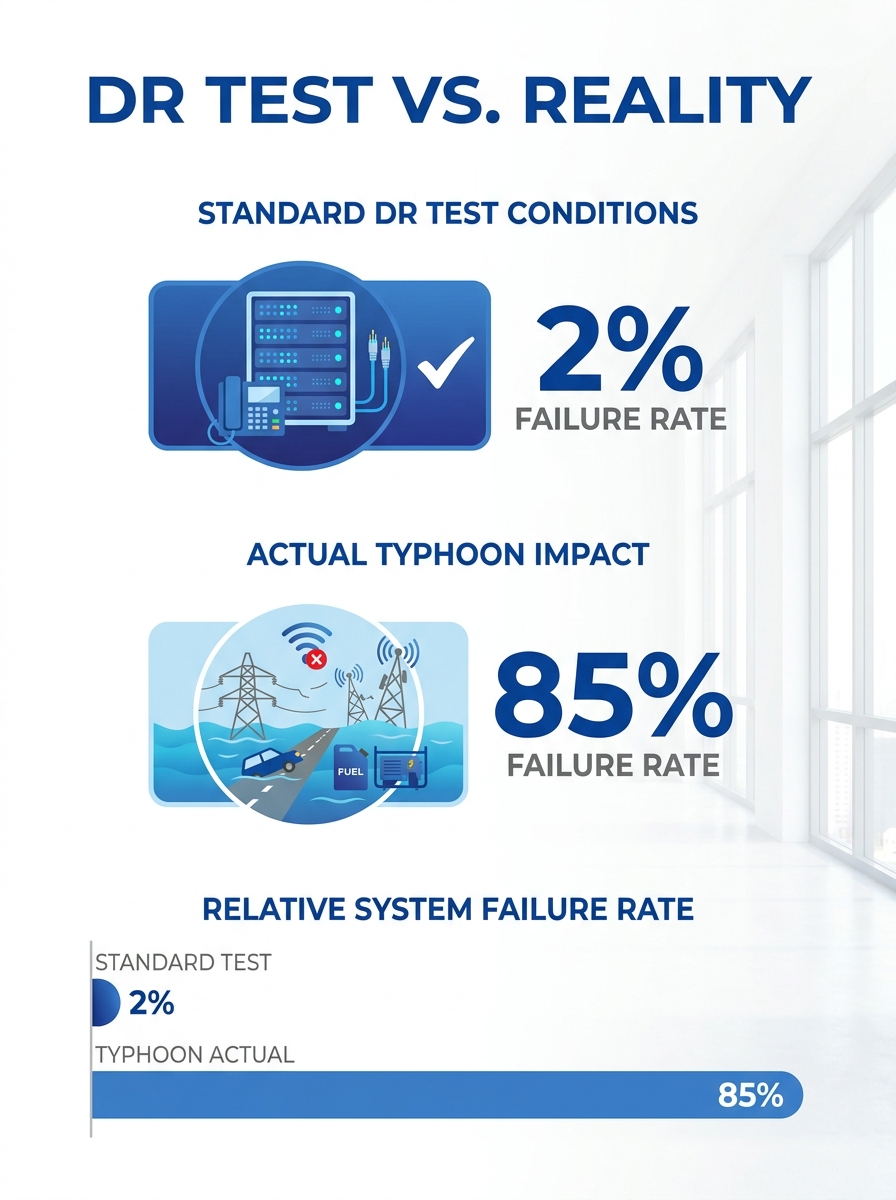
The standard DR test runs during business hours with stable power, full internet bandwidth, and IT staff standing by. That scenario has zero overlap with a Signal No. 3 or No. 4 typhoon event, where grid power drops across entire provinces and generator fuel becomes a logistics problem within 24 to 48 hours. A 2020 study of municipalities on Panay Island found that local disaster response units rated themselves “partially prepared” specifically because plans remained untested under realistic conditions. Enterprise IT departments share the same weakness.
Your SIP trunk failover configuration means nothing if the test never included a scenario where the primary data circuit, the backup LTE link, and building power all degrade simultaneously. Run your next DR drill with the main UPS on bypass and your primary WAN link administratively shut down. If your PBX and critical applications can’t recover to operational state within your documented RTO of 4 hours under those conditions, your plan has a gap that a real typhoon will expose.
Measure your actual RTO with the carrier link offline
Recovery Time Objective represents the maximum allowable duration for restoring a system after disruption. Philippine enterprises commonly document RTOs of 2 to 8 hours for voice and data systems. But those numbers assume that at least one carrier link remains active. During Typhoon Kristine (October 2024) and Super Typhoon Man-yi (November 2024), PLDT activated emergency business continuity protocols across its national network, and Globe subscribers reported widespread outages tracked in real time on Downdetector Philippines. When your primary and secondary carriers both go down, your documented RTO becomes fiction.
Tristan Burnett, IOM Chief of Mission in the Philippines, stated plainly after the 2024 typhoon sequence: “These storms are a stark reminder that preparedness saves lives. Communities did everything they could with the tools available, but stronger investment in safer shelters, resilient infrastructure, and locally led disaster planning is essential.” The same principle applies to enterprise telecom: you need infrastructure that survives the storm, not a plan that assumes the storm won’t touch your carrier.
Business continuity telecom Philippines planning should include at least two geographically diverse carrier paths. If your Metro Manila office relies on PLDT fiber as primary and Globe LTE as backup, and both traverse the same last-mile infrastructure in your building’s riser, you have one point of failure disguised as two.
Treat your telecom SLA as a ceiling, not a floor
Philippine contract law already provides grounds for termination when a telecom provider fails to deliver promised service availability. As legal analysis from Respicio & Co. notes, “most telco arrangements are reciprocal obligations: you pay; they deliver service,” and prolonged non-performance constitutes breach. But SLA credits don’t restore your operations. A 99.9% uptime SLA allows for approximately 8.7 hours of downtime per year. During typhoon season, a single storm can produce 48 to 96 hours of regional outage.
The DR plan gaps in Philippine enterprise networks often stem from treating the carrier’s SLA as the backbone of the recovery strategy. Your carrier will restore service when they can. Your enterprise needs to restore operations independently, which means local survivability for voice and data systems. On-premise PBX systems or hybrid configurations that can operate without a WAN connection for 24 to 72 hours provide this, and we’ve covered the total cost and resilience trade-offs between on-premise and cloud VoIP in detail.
Warning: If your cloud-only UC platform requires a stable internet connection to place even internal calls between floors of the same building, your voice infrastructure has zero survivability during a prolonged carrier outage. Local call control matters.
Pre-position your recovery assets before the storm signal drops
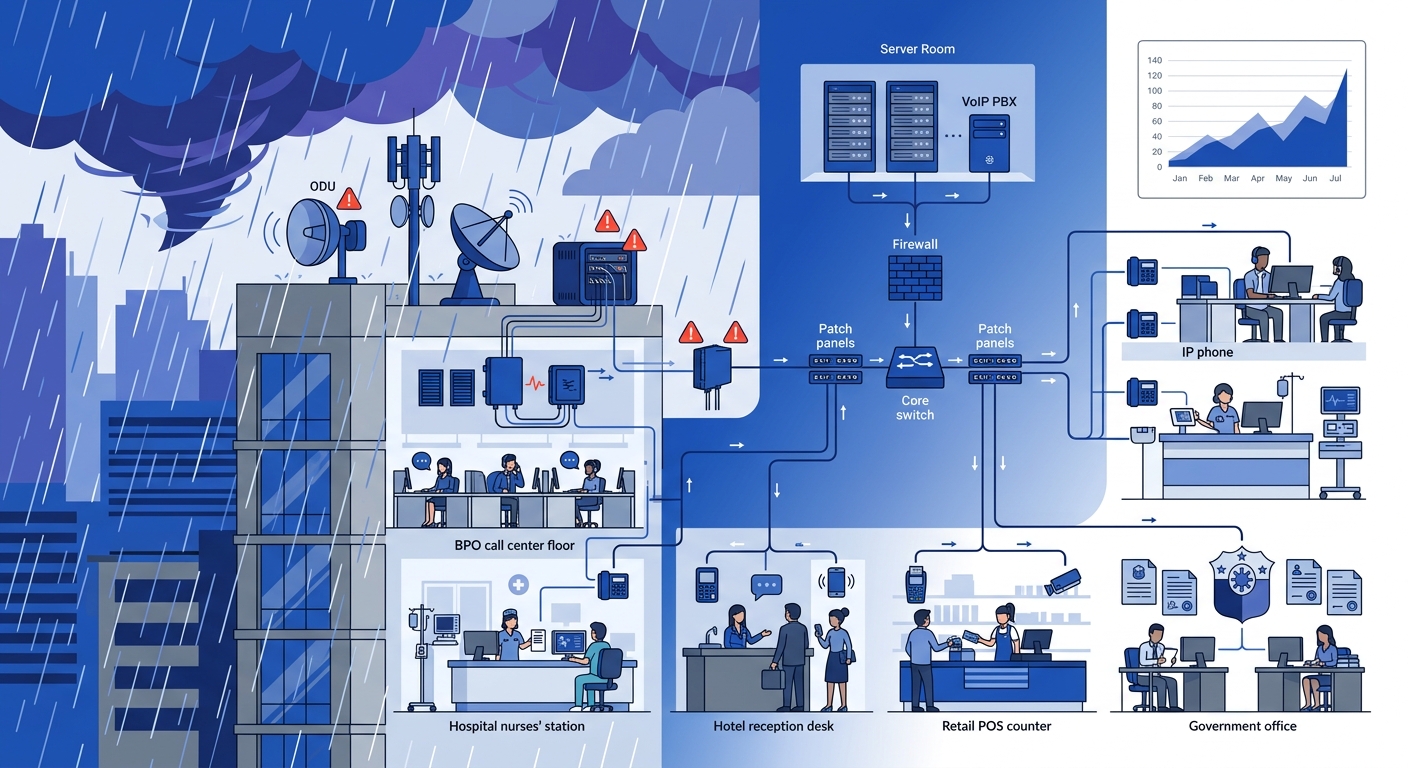
PDRF (Philippine Disaster Resilience Foundation) uses multi-hazard models that combine weather, ocean, and geospatial data to pre-position equipment and plan evacuation routes before typhoons make landfall. Enterprise IT should operate with the same logic. Once a typhoon is within 48 hours of landfall, roads flood, fuel becomes scarce, and courier services halt. If your DR plan requires a technician to drive replacement hardware from a Manila warehouse to a Visayas branch office after the storm hits, that plan will fail.
The 2024 cyclone season demonstrated this clearly. PDRF hosted virtual network briefings with member and partner companies to assess impact and identify gaps during Tropical Cyclones Trami and Kong-Rey. Companies that had pre-positioned backup routers, charged satellite phones, and verified generator fuel levels at branch offices recovered in 12 to 18 hours. Companies that hadn’t pre-positioned assets reported recovery timelines stretching beyond 5 days.
Keep a recovery kit at each site that includes a preconfigured backup router, a 4G/5G failover modem with a SIM from a different carrier than your primary, and at minimum 72 hours of generator fuel. Protect network equipment from water ingress: the Commission on Audit documented repeatedly that flood damage to ground-floor equipment was a primary cause of prolonged government service outages after Typhoon Haiyan. Mount critical infrastructure above projected flood lines and ensure proper cabling standards protect against water and debris.
Map cascading failures, because typhoons break everything at once
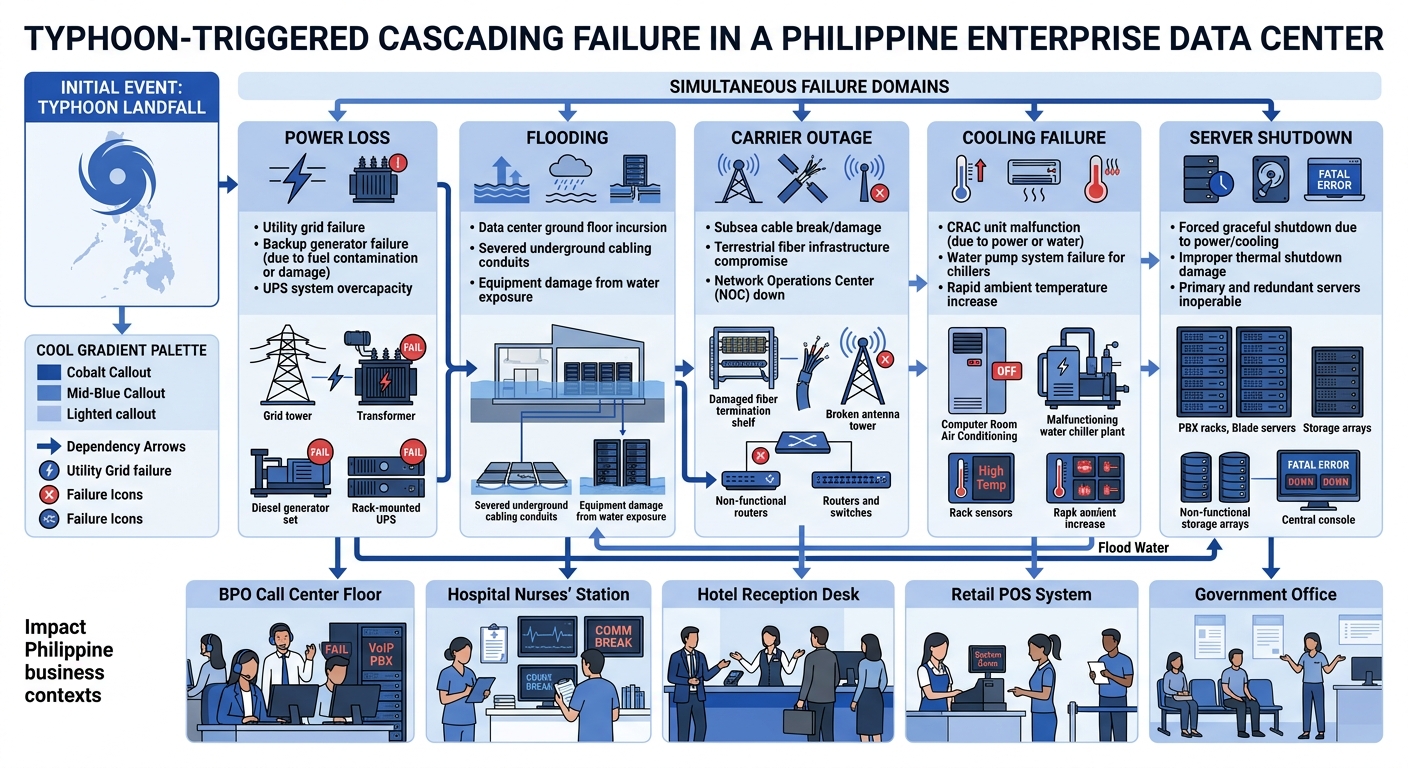
A data center cooling failure is a single-system event. A typhoon is a cascading, multi-system event. PDRF’s modeling shows that typhoons trigger floods and landslides simultaneously, and enterprise networks face the same compounding: power loss disables cooling, which forces server shutdowns, which drops the VoIP platform, which kills the call center, which triggers SLA penalties with BPO clients. Each failure feeds the next.
Your DR plan probably has a page for power failure, a page for network outage, and a page for facility damage. A typhoon hands you all three pages at once, and the plan never describes what happens when they overlap.
The ILO’s post-Haiyan needs assessment found that most Philippine SMEs “lacked the means to respond to destruction or recover quickly,” with businesses remaining vulnerable due to insufficient capacity to minimize losses from the approximately 20 tropical cyclones that cross the Philippine Area of Responsibility annually. Enterprise DR plans need a cascading-failure map that models the dependencies between power, cooling, network, voice, and application layers. If your digital resilience strategy treats each failure domain independently, you’re planning for an outage that typhoons don’t produce.
Protect the network perimeter as part of this chain. When backup links come up over public LTE after a storm, attack surface expands dramatically. FortiGate firewalls with failover-aware policies can enforce security posture even when traffic shifts to backup paths, preventing the post-typhoon recovery window from becoming a breach window.
Fund your DR budget with actual pesos, not spreadsheet allocations
The Commission on Audit’s review of government disaster response repeatedly found that local government units failed to back mandatory 5% calamity fund allocations with actual disbursable cash. The same pattern appears in enterprise budgets. Philippine enterprises commonly allocate DR spending as a line item in the annual IT budget, then defer hardware purchases, skip annual DR drill costs (typically P150,000 to P500,000 per site for a realistic multi-day exercise), and treat the allocation as a paper commitment.
A realistic disaster recovery Philippines typhoon budget for a 200-seat enterprise with 3 branch offices should account for: backup hardware pre-positioned at each site (P800,000 to P1.5 million per site depending on complexity), secondary carrier contracts with diverse routing (P25,000 to P60,000 monthly per site), generator fuel reserves and maintenance (P180,000 to P300,000 annually per site), and at least 2 full-scale DR drills per year. If your approved budget doesn’t cover these items with actual purchase orders, your plan describes equipment you don’t own.
When specifying server and storage hardware for DR sites, match the production environment closely enough that failover doesn’t introduce compatibility issues. A DR site running a different hypervisor version or storage controller model than production will surface problems you’ve never tested for.
When the Forecast Says Signal No. 5
These rules assume a planning window of weeks to months before typhoon season. When PAGASA issues a Tropical Cyclone Wind Signal No. 4 or No. 5 and your DR plan still has gaps, the realistic options narrow to three: activate whatever local survivability you have, confirm satellite or VSAT backup comms if available, and accept that your documented RTO will not hold.
The UN Resident and Humanitarian Coordinator in the Philippines, Gustavo Gonzalez, observed during the 2024 response that “the progress is outpaced by the rapidly worsening impact of climate change.” Enterprise IT planning faces the same acceleration. The typhoons of 2024 were stronger and more clustered than historical patterns predicted, and 2026 forecasts suggest the trend continues. A DR plan written for a Category 3 storm will not survive a Category 5 reality.
Review your plan now, during dry season, against these six rules. For each one where your honest assessment is “we haven’t done this,” schedule the fix before June. The rules themselves are straightforward. The hard part is the same as it has always been for Philippine enterprise operations: committing actual resources to a problem that feels hypothetical until the wind picks up and the lights go out.