
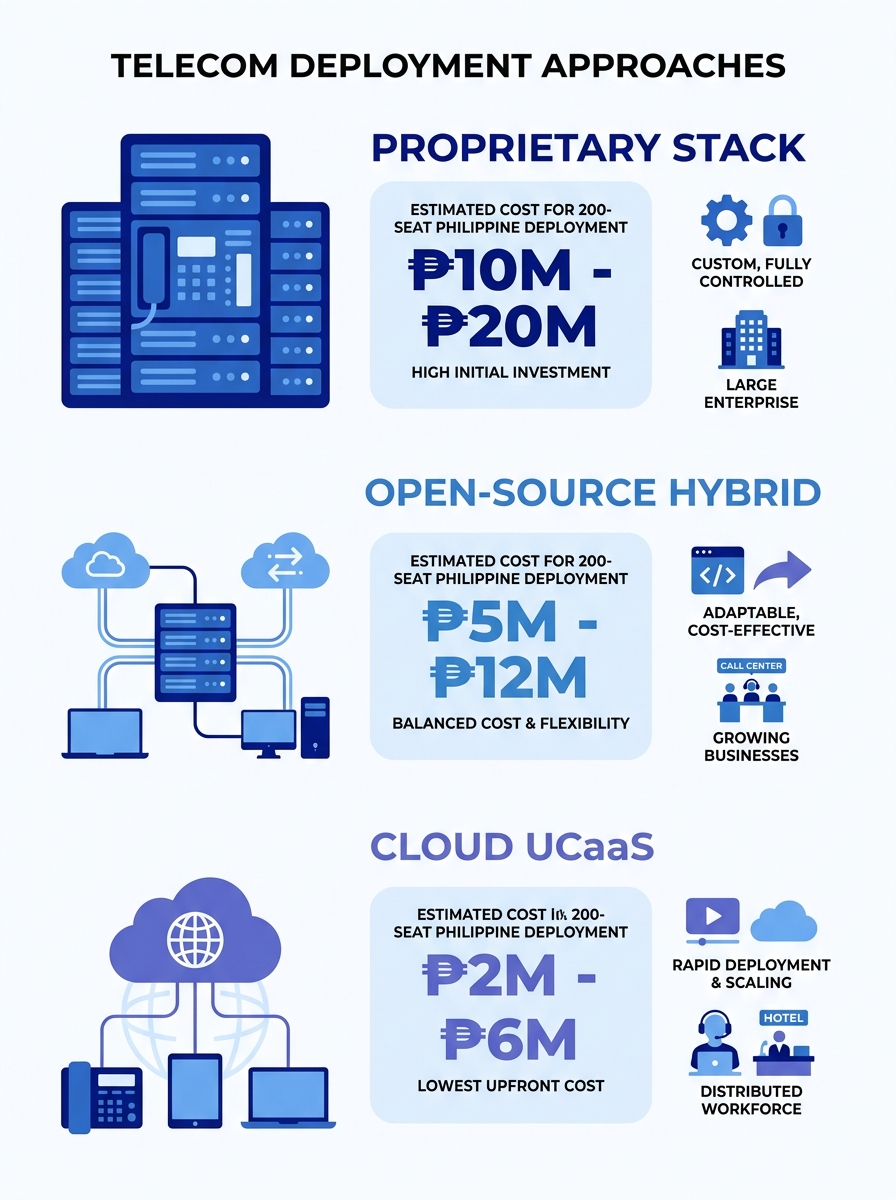
A 200-seat IP phone deployment in Metro Manila can cost anywhere from PHP 1.5 million to PHP 12 million depending on which architectural path you choose. The gap between those two numbers represents a fundamental choice about how your organization handles voice, video, and messaging for the next five to ten years. And the cheapest option upfront isn’t always the cheapest option at year three.
Philippine enterprises generally land on one of three approaches when building out telecom infrastructure: a fully proprietary stack from a single vendor, an open-source hybrid that mixes commercial hardware with community-driven software, or a cloud-hosted UCaaS model that shifts most capital expenses into monthly subscriptions. Each path carries real tradeoffs in reliability, flexibility, total cost of ownership, and the kind of IT team you need on staff.
This piece walks through all three, with specific numbers and considerations for organizations operating in the Philippine market. Whether you’re a BPO call center in Quezon City, a regional hospital in Cebu, or a government agency in Davao, the infrastructure decision you make here affects every department that picks up a phone or joins a video call.
The Fully Proprietary Stack
Cisco, Avaya, and similar Tier 1 vendors have been the default choice for Philippine enterprises with big budgets and conservative risk profiles. A Cisco Unified Communications Manager deployment, paired with Cisco IP phones and Cisco switches with proper QoS enforcement, gives you an end-to-end ecosystem where every component is designed to work together.
The appeal is obvious. You get a single throat to choke when something breaks. Firmware updates, security patches, and feature upgrades follow a coordinated release schedule. Interoperability testing happens at the vendor’s lab, not yours. For organizations that need to meet strict compliance requirements or operate under NTC and DICT oversight, the audit trail and vendor-backed SLAs carry real weight.
The cost is equally obvious. A Cisco UCM license for a 200-user deployment, including the servers, the IP phones, the gateway hardware, and the Smartnet support contracts, routinely lands between PHP 8 million and PHP 12 million for a medium enterprise. That figure doesn’t include the structured cabling, the PoE switches, or the network assessment work that should precede any deployment. If you’re looking at how enterprise data center infrastructure ties into your telephony, the proprietary stack often demands dedicated server hardware that adds to the bill.
Where Proprietary Wins
Verticals where uptime is non-negotiable tend to gravitate here. Hospitals running nurse call integration, BPO operations with strict client SLAs on call recording and analytics, financial institutions under BSP scrutiny. The proprietary stack gives you deterministic performance because every component in the chain is tested against every other component.
Cisco’s TAC support, while expensive, also means you’re not searching Stack Overflow at 2 AM when your SIP trunks stop registering. If your organization has already invested in Cisco networking infrastructure, adding UCM on top introduces less complexity than bolting on a different vendor’s phone system.
Where Proprietary Hurts
Vendor lock-in is the obvious downside, but the less discussed problem is upgrade rigidity. When Cisco deprecates a platform, you migrate on their timeline, not yours. The licensing model has also shifted toward subscription-based pricing in recent years, which means the capital expense advantage of “buying once” is eroding.
For smaller organizations with 50 to 100 seats, the per-user economics of a full Cisco stack are brutal. You’re paying for enterprise-grade redundancy features that a single-site operation may never use.
The Open-Source Hybrid Path
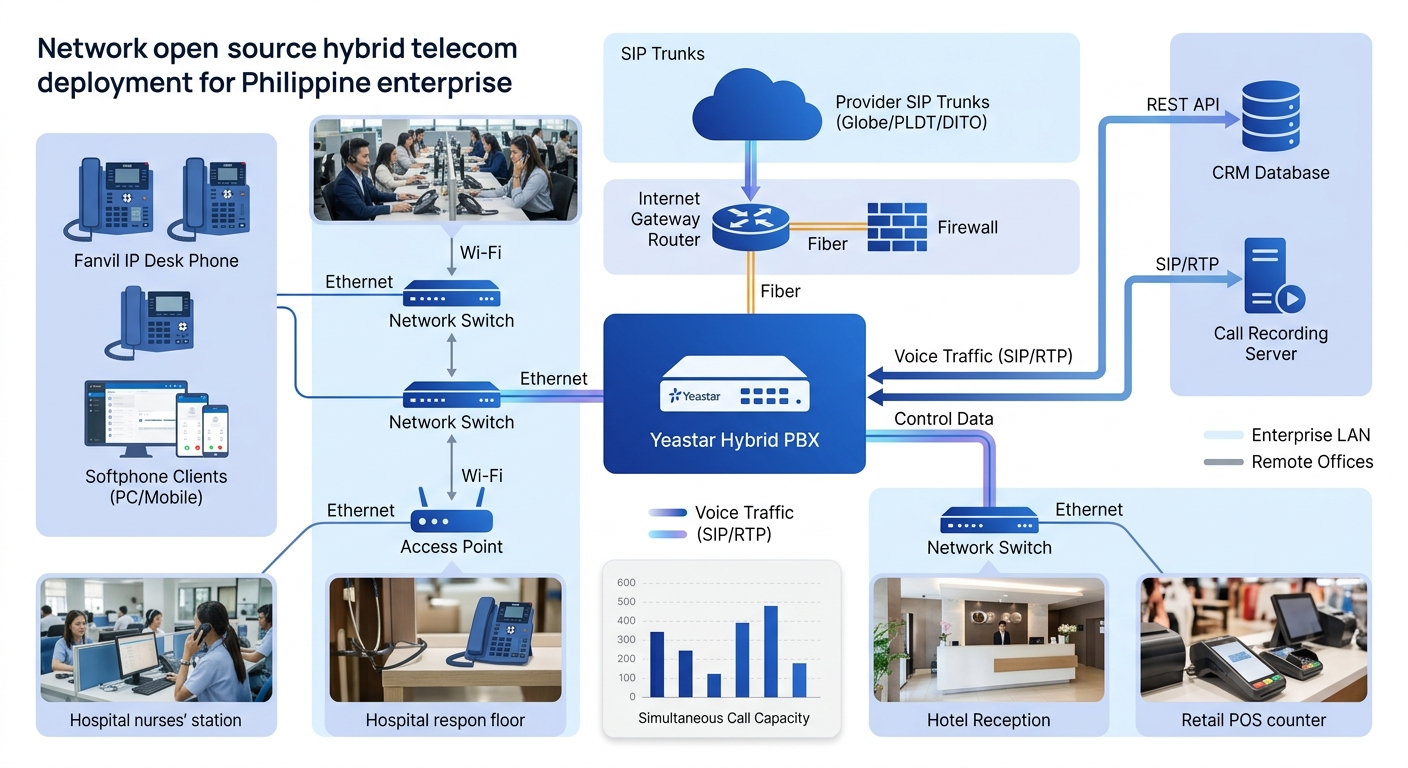
Asterisk, FreeSWITCH, and their commercial derivatives like FreePBX and Yeastar’s P-Series have created a middle ground where Philippine enterprises can build serious telephony infrastructure at a fraction of the proprietary cost. The approach pairs open-source PBX software with commercial SIP phones and standard networking hardware.
A typical hybrid deployment might run Yeastar P570 as the PBX appliance, Fanvil IP phones on every desk, Fortinet or Cisco Meraki for network security, and SIP trunks from a local ITSP. The hardware cost for 200 users in this configuration falls between PHP 1.5 million and PHP 3.5 million, depending on phone model choices and whether you opt for redundant PBX hardware.
The open-source telecom community has matured significantly. As the Technology Innovation Management Review notes, organizations can deliver a superior open-source telecom solution at far less cost than proprietary offerings, provided they follow a disciplined implementation approach. The key phrase there is “disciplined implementation.” Open-source doesn’t mean free if you count the labor.
Where Hybrid Wins
Customization is the standout advantage. Philippine BPOs that need specific IVR flows, custom CDR integrations with their workforce management software, or unusual routing logic for multi-site operations can modify the PBX behavior directly. Try doing that with a locked-down proprietary system and you’ll spend months in a vendor’s professional services queue.
The hardware flexibility matters too. You’re not locked into one phone vendor. You can deploy premium models in executive offices, mid-range units for general staff, and softphones for remote workers, mixing brands as the budget dictates. When we talk about the technical decision framework for hardware versus software phone solutions, the hybrid path gives you the widest range of options.
Cost scaling is more linear as well. Adding 50 seats to a Yeastar deployment means buying 50 phones and potentially upgrading a license tier. Adding 50 seats to a Cisco UCM deployment might mean a new server, new licensing, and a professional services engagement.
Where Hybrid Hurts
You need in-house expertise. Someone on your IT team needs to understand SIP at the protocol level, know how to read packet captures when calls drop, and be comfortable troubleshooting call quality degradation without a vendor support hotline walking them through it step by step.
The integration burden falls on you. Making your PBX talk to your CRM, your call recording system, and your contact center analytics platform requires API work, middleware configuration, and ongoing maintenance. Updates can break integrations. Nobody is testing your specific combination of components in a lab before releasing patches.
Warning: For organizations that don’t have at least one dedicated voice/network engineer on staff, the hidden labor cost of the hybrid approach can erode the hardware savings within 18 to 24 months.
The Cloud-Hosted UCaaS Model
RingCentral, Microsoft Teams Phone, Zoom Phone, and regional players like PLDT’s own cloud PBX offerings represent the third path. Here, you own almost no telephony hardware. The PBX lives in the provider’s data center. Your phones connect over the internet. Your monthly bill replaces your capital expenditure.
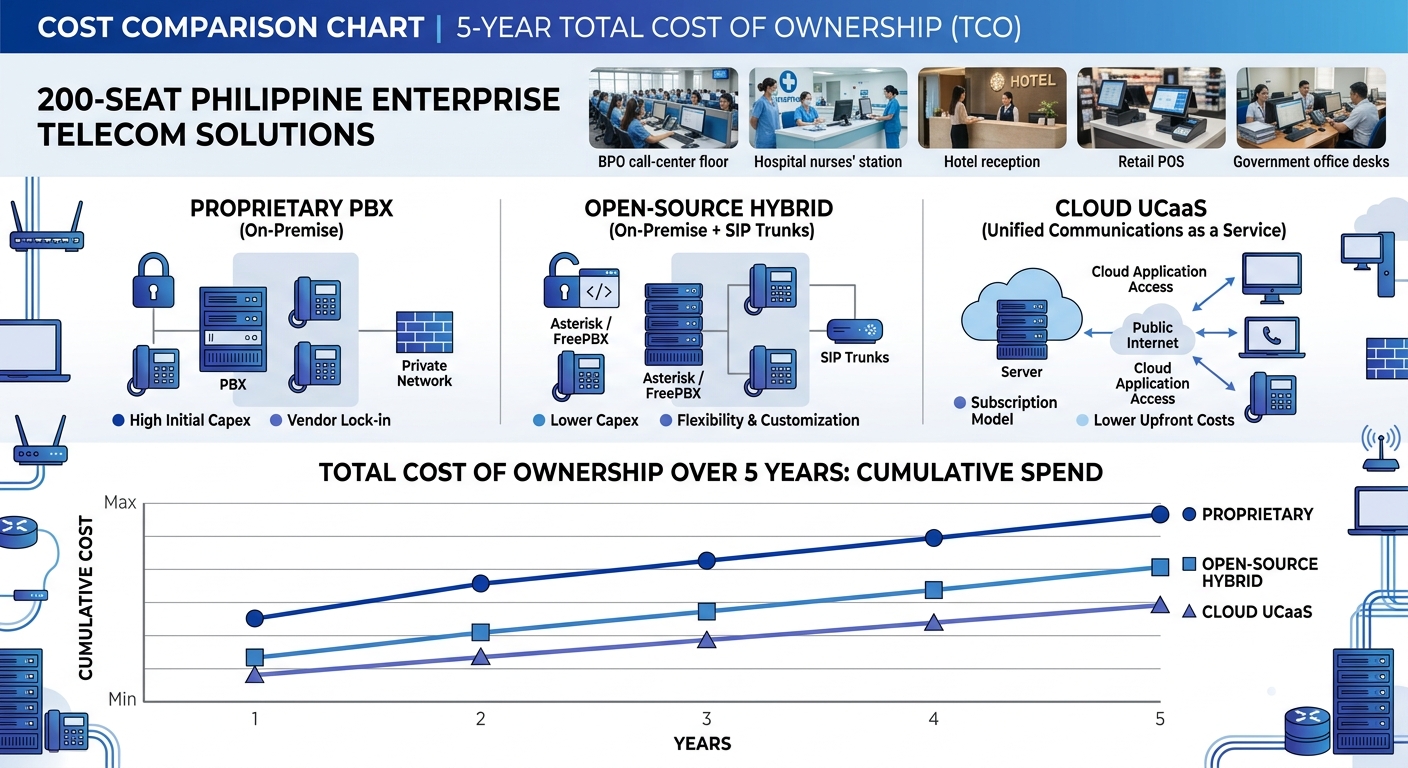
A 200-user Teams Phone deployment with E1/E3 licensing and a Philippine PSTN calling plan runs roughly PHP 80,000 to PHP 180,000 per month, depending on the licensing tier and call volume. Over three years, that’s PHP 2.9 million to PHP 6.5 million, placing it squarely between the hybrid and proprietary approaches in total cost of ownership.
The attraction for Philippine organizations with multiple branch offices is real. A hotel chain with properties in Manila, Cebu, and Boracay can run a unified phone system without maintaining PBX hardware at each location. A school network can add extensions for a new campus by provisioning licenses in a web portal instead of shipping hardware.
Where Cloud Wins
Speed of deployment is unmatched. A cloud UCaaS platform can be operational in days, not months. For organizations opening new offices or scaling rapidly, this matters. You avoid the procurement cycle for PBX hardware, the rack space, the UPS sizing, and the physical installation work.
Disaster recovery is built in. When Typhoon Kristine knocked out power in parts of Luzon, organizations on cloud PBX platforms could reroute calls to mobile apps and remote workers within minutes. On-premises systems without battery backup or failover architecture went silent.
The per-seat model also aligns well with organizations whose headcount fluctuates seasonally. BPOs that ramp up for holiday campaigns and scale back in Q1 can adjust their telephony costs month to month rather than sizing infrastructure for peak capacity year-round. If you’re weighing unified communications against standalone VoIP, the cloud model inherently bundles UC features like presence, messaging, and video into the same subscription.
Redundant lines, inactive services, and overlapping platforms are the silent killers of telecom ROI, and cloud deployments make them easier to spot in a single dashboard.
Where Cloud Hurts
Dependency on internet quality is the biggest risk factor in the Philippine context. A cloud PBX is only as good as the WAN link carrying your voice traffic. Offices in provincial areas with a single ISP and no fiber redundancy will have call quality problems that no amount of QoS configuration can fix. The network-first approach to resilient VoIP infrastructure we’ve discussed before becomes absolutely critical here, because the cloud provider can’t compensate for a congested last-mile connection.
Monthly costs compound. That PHP 120,000 per month looks manageable in year one. By year five, you’ve spent PHP 7.2 million with no owned assets to show for it. If your provider raises prices, your negotiating position is weak because migration carries its own cost and disruption. As one analysis of telecom digital transformation points out, overlooked redundant services and overlapping platforms can quietly destroy the ROI of even well-planned deployments.
Data sovereignty is a consideration for government agencies and regulated industries. Philippine data privacy regulations under the NPC require knowing where call recordings and CDR data are stored. Not every global UCaaS provider can guarantee that data stays within Philippine or ASEAN borders.
For organizations that need equipment financing to manage the cash flow of larger deployments, working with financing partners can make capital-intensive approaches more viable without the long-term subscription lock-in that cloud models impose.
Who Should Pick Which
The right answer depends on three variables that are specific to your organization: your in-house technical depth, your tolerance for monthly versus upfront costs, and how many locations you’re connecting.
Single-site organizations with strong IT teams and 100+ seats should look hard at the open-source hybrid path. The upfront savings are significant, the customization options are unmatched, and you have the staff to maintain it. Pair a Yeastar or Asterisk-based PBX with quality SIP phones, invest in proper network assessment before deployment, and you’ll have a system that costs 60–70% less than the proprietary equivalent over five years.
Multi-site organizations without dedicated voice engineers should start with cloud UCaaS. The operational simplicity of a single platform across all locations, with built-in redundancy and no hardware to maintain, outweighs the higher long-term cost. Budget for redundant internet links at every site and you’ll avoid the call quality problems that plague underprepared cloud deployments. Matching your UC platform to your actual security model and change capacity matters more than chasing the lowest per-seat price.
Regulated enterprises, large hospitals, and government agencies with compliance mandates still have legitimate reasons to go proprietary. The SLA-backed support, the certified interoperability, and the vendor accountability for audit trails justify the premium. If you’re spending PHP 8 million on a phone system, make sure you’re also investing in the network infrastructure to protect it.
And one approach that’s gaining traction among mid-market Philippine enterprises: start hybrid on-premises for your headquarters where call volume is highest and you have IT staff on-site, then extend to branch offices via cloud UCaaS. This split model captures the cost efficiency of owned infrastructure where it matters most while avoiding the complexity of managing PBX hardware at remote sites with no technical staff. It’s more complicated to design, but for organizations with one large office and several small branches, it’s often the most honest answer to a question that doesn’t have a single clean solution.