
PLDT Inc. will deploy internet infrastructure to over 3,500 sites in geographically isolated and disadvantaged areas through partnerships with three national government agencies, the telecommunications company announced May 10.
The Pangilinan-led telecommunications provider is coordinating with the Department of Information and Communications Technology, Department of Education, and Department of the Interior and Local Government to expand connectivity in underserved and far-flung areas, according to BusinessWorld. The rollout forms part of PLDT’s efforts to address persistent coverage gaps in remote communities nationwide.
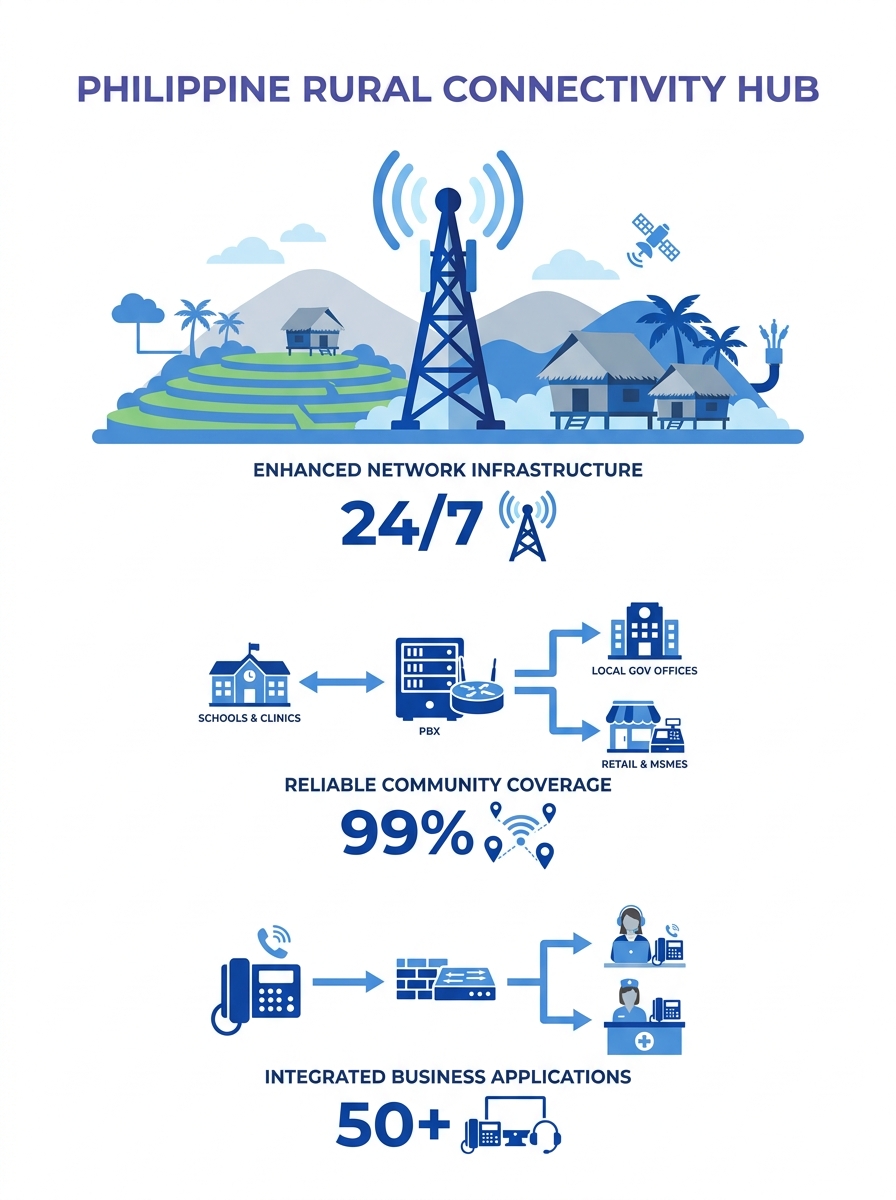
Roderick S. Santiago, PLDT and Smart’s Head of Network Strategy and Architecture, said the public-private coordination enables the telco to overcome longstanding deployment obstacles. “Strategic collaboration with the government allows us to overcome long-standing challenges in infrastructure deployment,” Santiago stated in a May 10 media release. “When public and private sectors work in sync, we can speed up connectivity rollouts and ensure that even the most remote areas benefit from the country’s digital transformation.”
Deployment Targets Multiple Sectors
PLDT stated the expansion aims to accelerate network deployment across the country to support online learning, enhance government service delivery, and enable businesses of all sizes to participate in the digital economy. The company did not disclose a timeline for completing the 3,500-site buildout or specify which provinces or municipalities will receive coverage first.
The telecommunications firm has engaged with government agencies and industry stakeholders to streamline permitting processes in the sector. That coordination effort addresses regulatory and administrative challenges that have historically slowed telecom infrastructure rollout in remote areas.
Broader Connectivity Push
The rural expansion represents PLDT’s latest infrastructure initiative following its recent deployment of agentic AI tools for enterprise client support and sales operations. While those AI implementations target urban business customers, the rural site rollout extends the company’s reach into areas where basic connectivity remains limited or nonexistent.
For enterprises evaluating VoIP infrastructure in Philippine government agencies, expanded rural coverage could enable remote offices and field sites to adopt cloud-based telephony systems. Reliable last-mile connectivity is a prerequisite for deploying unified communications platforms beyond Metro Manila, Cebu, and Davao.
Government Implications
The three-agency coordination model signals a shift in how Philippine infrastructure deployment addresses connectivity gaps. DICT, DepEd, and DILG each hold jurisdiction over distinct site types—government offices, public schools, and local government units—that collectively represent significant portions of the 3,500 target locations. That multi-agency structure could accelerate right-of-way approvals and site clearances that typically delay rural tower construction.
Government IT managers should track which municipalities gain coverage through this rollout. Agencies operating field offices in GIDAs may need to reassess network architecture once fiber or fixed wireless options become available. The expansion also creates opportunities for government-to-government digital services that require reliable two-way connectivity to function, including telemedicine consultations and remote education platforms.
PLDT’s focus on permitting streamlining suggests regulatory friction remains a constraint on rural buildout speed. If the company demonstrates faster deployment timelines through this coordinated model, other carriers may adopt similar government partnership structures to expedite their own coverage expansion mandates under National Telecommunications Commission directives.